
In his recent Thanksgiving letter, Warren Buffett highlighted several interviews conducted by Charlie Rose with leaders closely connected to Berkshire Hathaway.
So I dug up Capital Cities/ABC chief executive Tom Murphy’s appearance on the PBS program which aired on August 4, 1995. In this episode, Murphy offers a masterclass in leadership, capital allocation, and building enduring businesses. The conversation catches him at a pivotal moment, shortly after orchestrating the sale of his beloved Cap Cities/ABC to The Walt Disney Company. Enjoy!
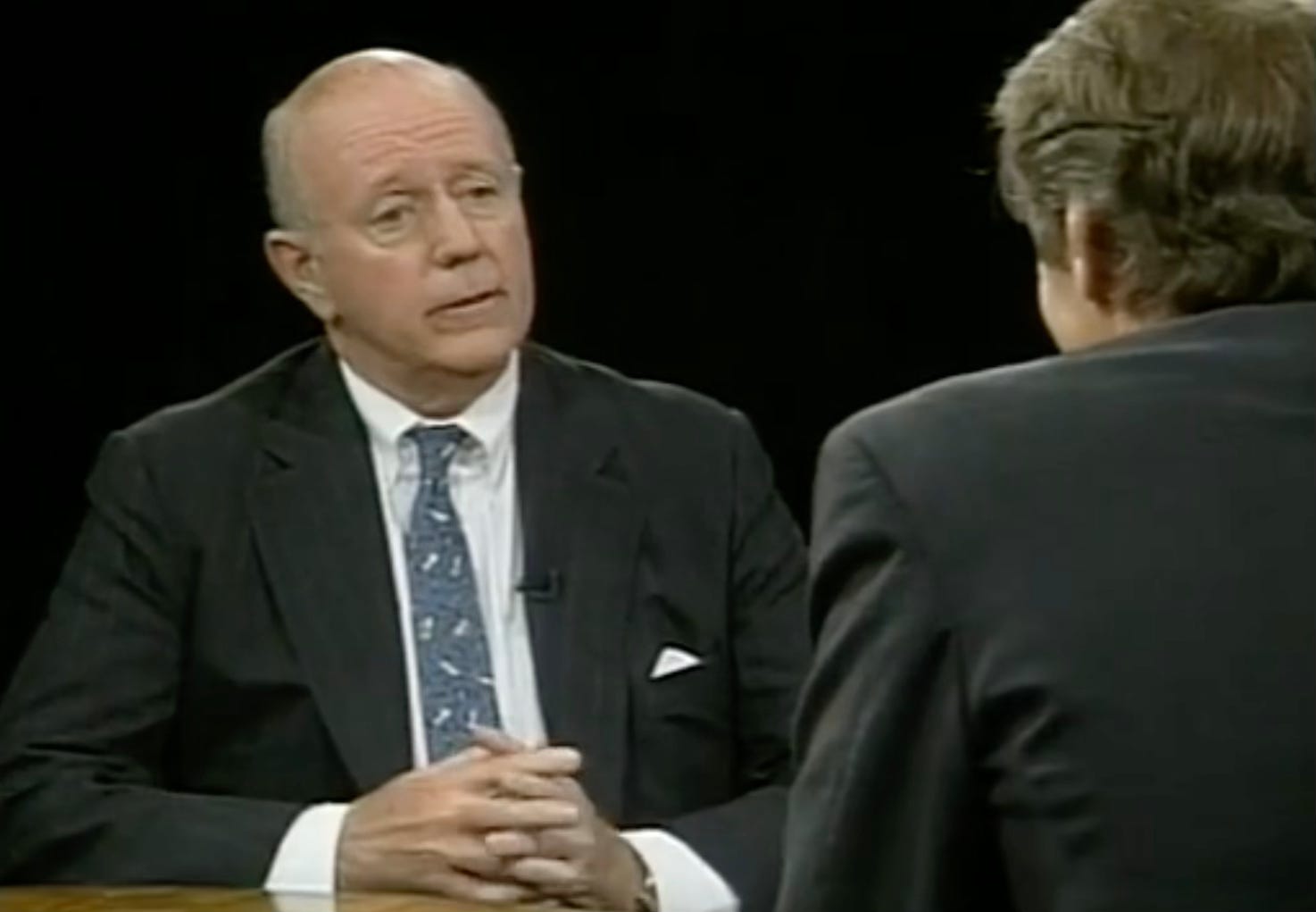
Note: I summarized and/or condensed some of Charlie Rose’s questions for brevity and clarity.
Charlie Rose: This is an American story. A young man without great wealth gets a great education and he starts at the bottom with a little company, a UHF television station. He finds a partner and together they build — brick by brick — a big company. Then they find another party, a financial genius, one of the world’s richer men. Then they buy a network and make it better. The stock continues to appreciate and split and appreciate.
They are tough, but they are gentlemen — and, one day, they get taken over by an even bigger company so they can do their thing on the global stage.
The founder is Tom Murphy. His partner is Dan Burke. His backer is Warren Buffett. The company is Capital Cities, which becomes Capital Cities/ABC — which becomes Capital Cities/ABC, a division of The Walt Disney Company. It is now one of the largest media companies in the world.
Tonight, a conversation with Tom Murphy.
Welcome. It’s great to have you here.
Tom Murphy: Thank you.
It’s been a hell of a week, hasn’t it? (Laughing)
It’s been interesting — and exciting.1
What’s been the most exciting thing about it for you?
For me, it’s the feeling — after a couple of days — that we made the right decision. That it was right for stockholders, it was right for our employees, and I think in the long run it’s going to be right for the public.
It’s been affirmed in almost every way. I mean, the market has affirmed it. Even your competitors have said this was a good deal and makes you tougher to compete with.
They have.
Worth coming out of retirement for?
Yes, it was. That’s right.
And a long way from Albany when you started.
I’ll say. 41 years ago.
What were you thinking when you left New York to go up there and take over that little bankrupt station?
Charlie, I was thinking that it gave me the chance to run something. I was 29 years of age and I thought I could run something. I didn’t necessarily have any reason to think that, I just inside felt I could. The fellow who really hired me up there — I was the first employee up there — said, “Look, if you go up there and you make it big, I’ll see to it that you make $250,000 after five years. And if you don’t, you’ll have terrific experience and you’re still young enough that you can come back to New York and go back in the advertising business.” Which I came from.
Was it called Cap Cities then and was Lowell Thomas an original investor?
It was called Hudson Valley Broadcasting, which was the company we took over which was about to go into bankruptcy. Lowell’s business partner was a fellow named Frank Smith, but Lowell was the biggest stockholder.
The total amount of money originally going in, as I recall now, was about $750,000. There were about eight private investors.
Many years ago, right out of law school, someone invited me to come to the Cap Cities office right off Madison Avenue.
Right behind St. Patrick’s Cathedral.
Did you keep an office for Lowell Thomas there?
Yes.
He had an office?
He did all the time. We had pictures of all the wonderful places he had been and all the wonderful people he had met.
It is said that you used to — while running Cap Cities — keep on your desk a list of companies that you might want to buy.
That’s right.
Was there no company for Cap Cities to buy now, before this acquisition?