
On March 28, 2019, Warren Buffett headlined The Gatehouse’s “Hands Up for Success” luncheon near Dallas, Texas — and joined CNBC’s Becky Quick on stage for a forty-minute conversation about his investing career and philanthropic work.
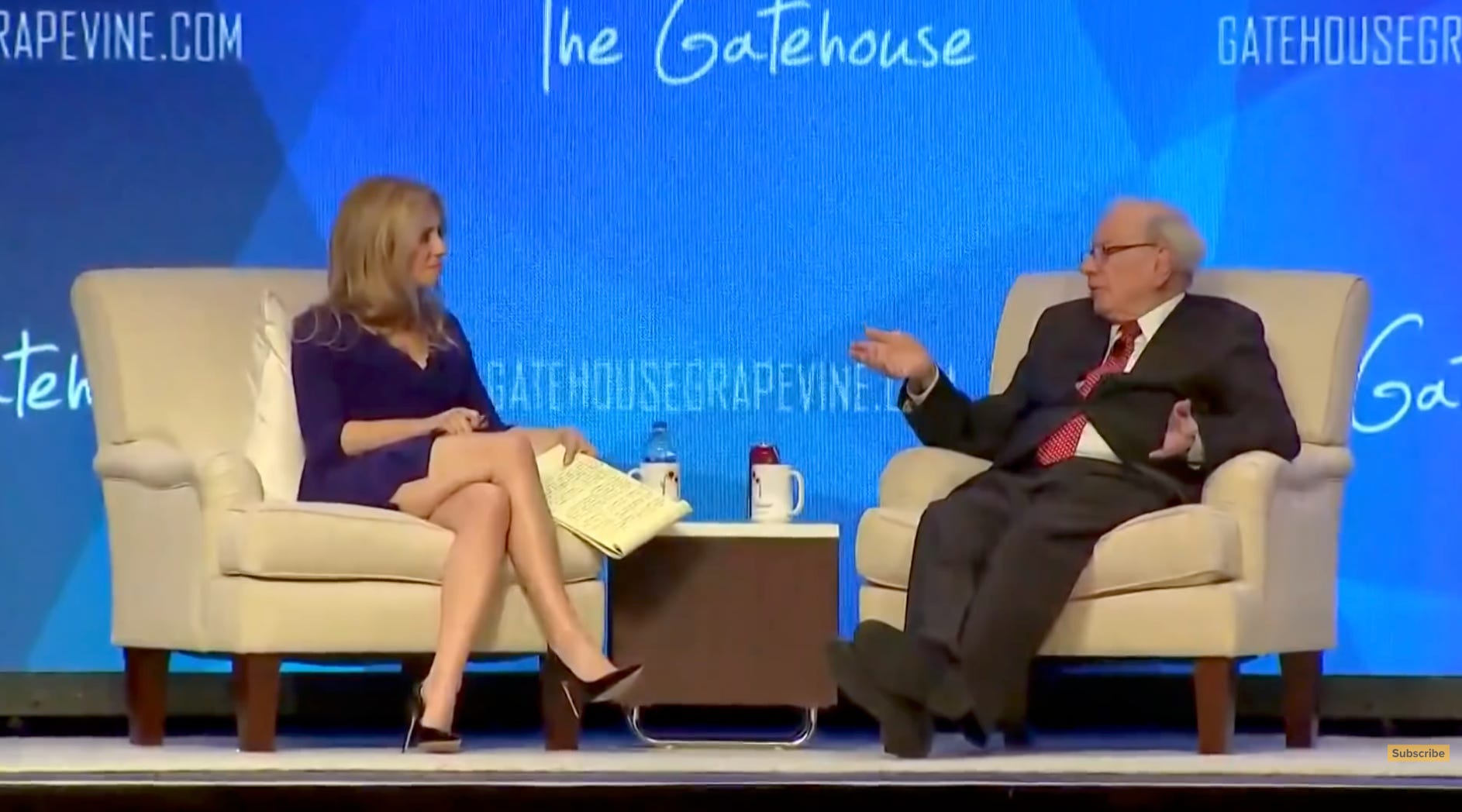
Buffett’s appearance came courtesy of former BNSF Railway CEO Matt Rose, a longtime supporter of The Gatehouse. This is a very interesting interview — one that I had never seen before — that delves into different areas (like streaming, real estate, and more) than the typical Buffett Q&A session. Enjoy!
A couple of quick notes: I condensed and summarized some of Becky’s questions to keep the spotlight on Buffett’s answers. I also omitted a brief discussion of the Gates Foundation near the end, since that is no longer relevant to Buffett and Berkshire watchers.
Becky Quick: You called the BNSF Railway acquisition a huge bet on the future of the American economy — and that bet paid off in a big way. In fact, this year in the annual report you wrote about BNSF as one of the towering redwoods in the grove that is Berkshire Hathaway. Looking back on nine years, what can you say about what has happened since?
Warren Buffett: It is the tallest redwood in the Berkshire forest. It was a seminal time for Berkshire, in either the last days of October or the early days of November of 2009, [when] Matt [Rose] and I talked at a small hotel in Fort Worth. Our directors are going to meet there in the fall — it will be the tenth anniversary [of the BNSF deal]. I’ve had so much good luck in Texas, but nothing rivals the BNSF acquisition.
One thing you may find interesting [is] I had a talk with Matt, I guess it was the Monday following the Friday I was out here with him. We more or less had the deal and then I called our lawyers and I said, “You fellows can bill me for all the hours you want between now and Sunday at noon. And after that, you’re working for nothing.”
We compressed that deal into a one-week period or so that otherwise probably would have taken months if I hadn’t made that restriction. Those of you who have dealt on corporate deals will understand why I stuck that in. (Laughs)
Matt is retiring next month. What are you going to do without him?
He has left us a great, great railroad. It is the towering redwood at Berkshire and we’re going to take good care of what he has built for us. I think I described it as being a bet on the country and a 100-year asset. It’s more than a 100-year asset, but I thought that would probably be as long as I would be around. I didn’t want to speak beyond my tenure. (Laughs)
It is so fundamental. It moves more than 15% of the ton miles in terms of inter-city traffic in the United States. It’s important not only to Berkshire, [but] it really is important to the country. And it has been treated by Matt like it was important to the country. He realizes that it has a significance that goes well beyond that of virtually any businesses in making sure that this country works the way we want it to work.
Warren, you’ve been fascinated with the railroads since you were a kid.
Right.
Now, you look at it as something much more than just a fun toy. You watch this as something that’s a real way of measuring the economy. You talk all the time about the car-rail loads. What are you seeing right now when you look at that statistic and what does that tell you about the economy?
It’s distorted in the last week or two by the floods in the Midwest — and we move a lot of coal — but there are twenty-odd categories that the railroad industry reports on for all the railroads. Winter is always a little bit of a tricky thing, but I would say that it looks like it’s slowing down. I don’t mean it has reversed in course or anything, but it does seem [that way] from all of [our] businesses, but especially including railroad statistics because they come so fast and they cover such a broad spectrum.
It gets distorted by whether people are hurrying up the Pacific trade because they’re worried about tariffs and all of that sort of thing — but I would say it does look like the pace of increase in the economy has slowed down. I would call it somewhere close to noticeably, but I wouldn’t go beyond that.
Have you seen it broadly or are there a couple of areas where you see more weakness?
There are these twenty-odd categories, like autos and aggregates [and] grain. Almost all of those categories throughout last year were trending strong. And I would say, just looking at those figures — but also looking at a good many other figures I see on a weekly basis — it looks like things have slowed down. You always have the weather factor. That’s the way I would bet looking at what I see today.
That doesn’t change anything we do. If there was a flashing red light, if there was a blaring red light, we would keep investing the same way we do.
Just look at the railroad in terms of what the situation was in the fall of 2009. It looked like the end of the world and it turned out that that was the low quarter, the third quarter. You really want to bet on America. [We] listened to that magnificent rendition a few minutes ago. God has blessed America.
I don’t want to get too wonky on this, but the yield curve — when you look at the ten-year versus the three-month — has inverted. This is a pretty important recession signal. It has signaled every recession that we’ve seen in the last fifty years and it has only given an incorrect signal once. This is the first time it has inverted since 2007. Do you see a recession on the horizon?
I just hope I see a lot of recessions. I hope I live long enough! (Laughs)
I don’t know how many recessions I’ve lived through. I was born on August 30, 1930, and the Dow was a little over 250. By the time I got out of college, there was only one or two days after my birth that it had been that high. I don’t know whether I’ve lived through eight recessions or six recessions or you name it, but that’s part of the capitalistic system.
We will have them — and it won’t change anything Berkshire invests in. It may offer us more opportunities, in marketable securities or businesses.
If we see a good business and everybody in the world is bearish and that [yield curve] inversion has gone to a hundred basis points or something like that, we’re going to buy it. And we will buy it enthusiastically.
You’ve talked an awful lot in the past about how high yields act as gravity on stock prices — so if you’re seeing really low yields that, inversely, could mean that stocks should trade a lot higher. What do you think of that?
