
I’m not really sure if it’s correct to call the never-before-released interviews from Warren Buffett: A Life and Legacy “new” or not. After all, the Buffett footage is about eight months old — even though CNBC only aired it for the first time in recent days.
Either way, we’re talking instant classics here.
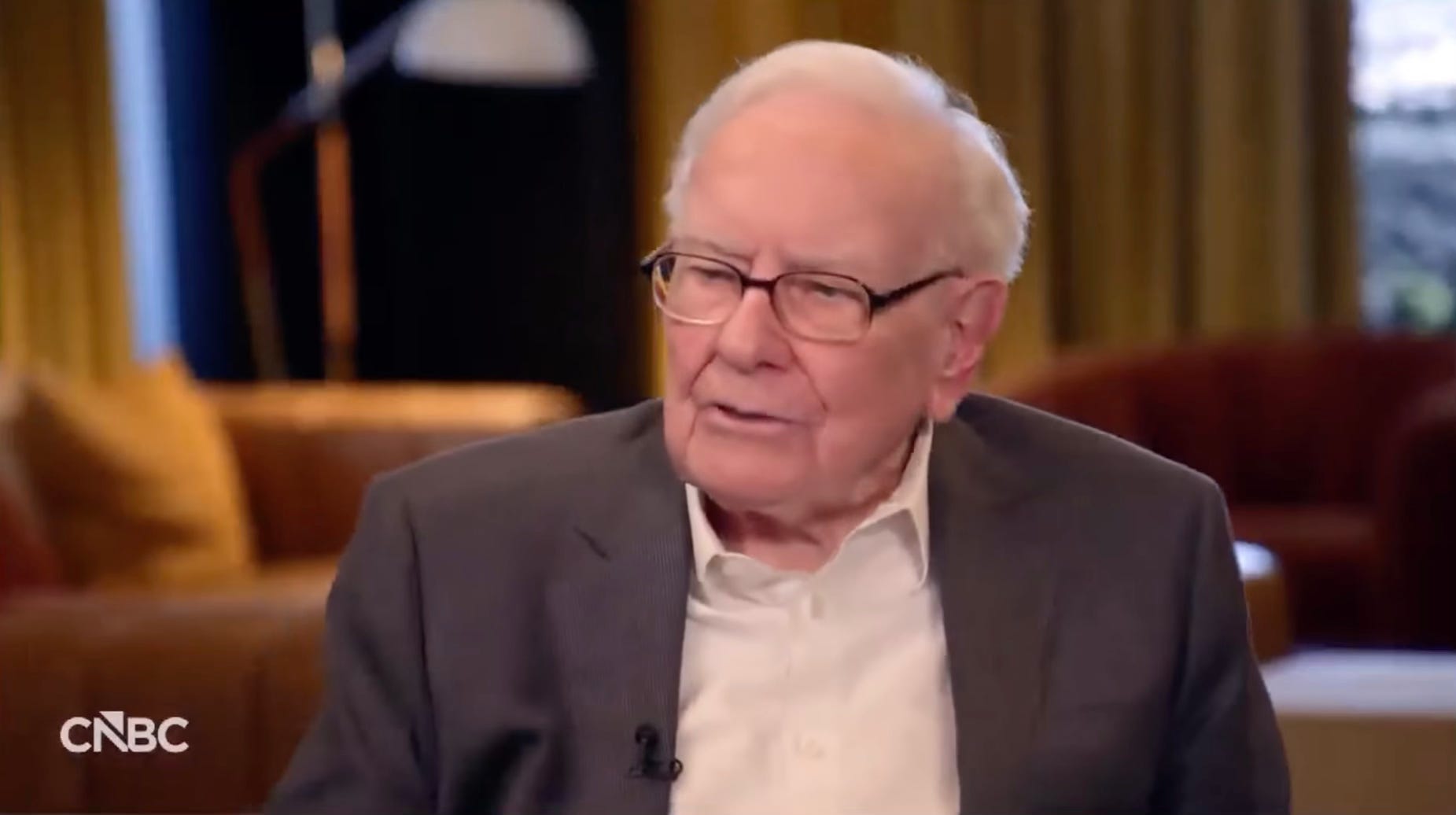
In these conversations — hosted by Becky Quick as part of a broader two-hour special that also included insights from Buffett’s children — he directly addresses some of the most pressing questions on Berkshire Hathaway shareholders’ minds.
With Greg Abel now CEO — the first change at the top in more than fifty years — people naturally wonder how the transition will unfold and what the conglomerate will look like in the post-Buffett era. Questions about continuity, culture, and strategy.
Buffett delivered a clear, reassuring message. Everything will remain just about the same, guided by the same timeless principles that made it a legend, only better with Abel (and his operational chops) in charge.
(1) What made this the right time to retire?
Two reasons: Father Time, held at bay for so long as Warren Buffett confounded skeptics and naysayers, finally seemed to be gaining ground on the nonagenarian. And, secondly, he had the perfect person waiting in the wings to take over.
“Greg [Abel] can do anything I can do,” said Buffett, “and he can do it way, way better. [And] he didn’t seem to mind waiting.”
“It’s also true that a few years ago — and it wasn’t more than a few — I began to get older. It wasn’t a terrible thing and I’ve been happy, but my balance has changed, my voice has changed somewhat, and it just happens to people at different ages.”
Like it or not — and I, for the record, don’t like it — this is something that will happen to all of us in time. “Very few people,” said Buffett, “and very few males, particularly, get to 95 without beginning to [feel] older. It doesn’t mean the world falls apart or anything like that, it just means you can’t do certain things that you could do before. Greg is the [right] person to be running Berkshire right now.”
“There wasn’t anything emotional about [my retirement announcement] at all,” continued Buffett. “From the moment I bought [Berkshire], I knew I wasn’t going to run it into eternity or anything. Everything I wanted to have happen has worked out. That doesn’t mean everything we’ve done has worked out, but I couldn’t imagine more fun than I’ve had running Berkshire.”
(2) Is Greg Abel equipped to run Berkshire’s stock portfolio?
For so long, Berkshire Hathaway shareholders thought we had a pretty good handle on how the conglomerate’s massive stock portfolio would be run post-Buffett.
Todd Combs and Ted Weschler were brought on board more than a decade ago, gradually given larger slices of capital to manage, and widely expected to inherit the whole thing sooner or later. But that has changed somewhat, with Combs leaving for JPMorgan Chase earlier this month — and Buffett making a point in recent years to emphasize that Abel, as CEO, should have primary control over the portfolio.
He does not sound at all worried that Abel’s relative inexperience in this area will be a hindrance. “If you understand business,” said Buffett, “you understand the equity portfolio. We buy businesses like we buy marketable stocks and we buy marketable stocks like we buy businesses. They are businesses!”
“[Greg] works way harder and more efficiently than I do and he knows more about certain industries. It doesn’t take a genius — and it sure doesn’t take any Greek symbols or anything like that — to figure out what a business is worth. I happen to have a guy who can run businesses — and if you can run businesses, you can value businesses. Unless you’re nuts and listen to the wrong people.”
Here, Buffett ties portfolio management less to specialized market wizardry and more to deep business acumen. Something, obviously, he believes Abel has in spades.
(3) What about all that cash?
At last count, Berkshire Hathaway was sitting on an astounding $354 billion of cash. This did not happen by design but rather a confluence of “external circumstances” that prevented Warren Buffett from deploying all of that dry powder at immense scale.
In other words, he was still out there looking to bag his elephant until the very end — but could not find any opportunities of appropriate size and attractive value.
“When I look at the stock market,” said Buffett, “when I look at companies of a size that would make any difference to our total, I don’t see anything. But I am willing to spend $100 billion this afternoon. I’d rather have $100 billion in a really good business bought at a sensible price than have $100 billion in cash.”
“Cash, at a certain level, is necessary — but cash is not a good asset.”
Buffett revisited one of his favorite analogies to hammer home the point. Cash is like oxygen — absolutely essential and something you never want to be caught without. But also something you don’t need too much of.
Patience is a virtue when prices are frothy, but the ultimate goal always remains to deploy cash into great assets at fair valuations — not to hoard it indefinitely.
(4) Will Berkshire’s board trust Abel to make big acquisitions on his own?
One of Berkshire Hathaway’s longstanding competitive edges has been its ability to move with extraordinary speed when making decisions. If a business owner called Omaha offering to sell, Warren Buffett could usually provide an answer in minutes.
And, if the answer was yes, the seller knew Buffett’s word was gold. The check would clear promptly, there would be no delays, no renegotiations or other chicanery. The famed Berkshire handshake carried immense weight because Buffett did not need to consult the board, seek committee approval, or navigate any layers of bureaucracy.
But, with Buffett no longer the one calling the shots, will Berkshire under Greg Abel still have the ability to make decisions so quickly?
The answer: Pretty much.
“The big question is how big of a deal should [Greg] be able to do without getting the board’s approval,” said Buffett. “That’s the one they all get stuck on. But [the board] was fine with that … They basically [signed off on Greg’s ability to make a big deal].”
“They all ended up in agreement and Steve Burke finally said, ‘We don’t need to sit around for three months and peer at our navels. This is the right decision.’”
“[Greg] will have a lot of authority [to make big deals without board approval],” concluded Buffett.
That latitude will be bolstered by Buffett’s ongoing commitment to Berkshire. “How many CEOs in the country are willing to never sell a share before their death?” he asked. “That’s an unusual asset for the company to have.”
(5) How will Berkshire Hathaway change in the future?
Warren Buffett’s message was mostly one of reassurance that “The Berkshire Way” will be upheld by his successor — but also acknowledged that change is inevitable.
Berkshire will never stand still — continuing to evolve and adapt for as long as it keeps on kicking. “[Berkshire] will always be moving somewhat,” he said, “but mostly expanding. But, occasionally, there will be things that disappear. We will have companies that — 50 or 100 years from now — will not be viable in the economy of that world, but we will have a whole lot more that developed over the years.”
“We can go wherever the country goes. We can go with capital. Greg understands more businesses, in a sense, than I do. I understand pretty well the ones that came along while I was expanding Berkshire, but if you ask me whether I know much about the companies that are being formed today, the answer is no.”
As some of Berkshire’s owned businesses inevitably fade — or even obsolete — in the years and decades to come, others will emerge to take their place, fueled by the conglomerate’s ability to allocate capital opportunistically. Long may that continue.
That was really good, Kevin. Thanks.
It does feel that leaving such a huge amount of cash accumulated for Greg Abel is a potential poisoned chalice - it really would have been better for Buffett to return a portion of it as a dividend, making it easier for Abel to do the same in the future - there's only so long that someone not called Warren Buffetr will be able to resist shareholder pressure to do something with the cash in the long-term, post-Buffett.