
Greg Abel jetted over to Japan last week and logged some priceless face time with the leadership of the five trading houses, Tokio Marine, and Tungaloy (one of the smaller cogs in the sprawling Berkshire Hathaway machine).
The Berkshire CEO also carved out twenty minutes to hop on CNBC and discuss his trip to Japan as well as other timely matters on shareholders’ minds. And, once again, we saw that Abel is all business — with an impressive command of both the granular mechanics of the conglomerate and the larger economic currents of the moment.
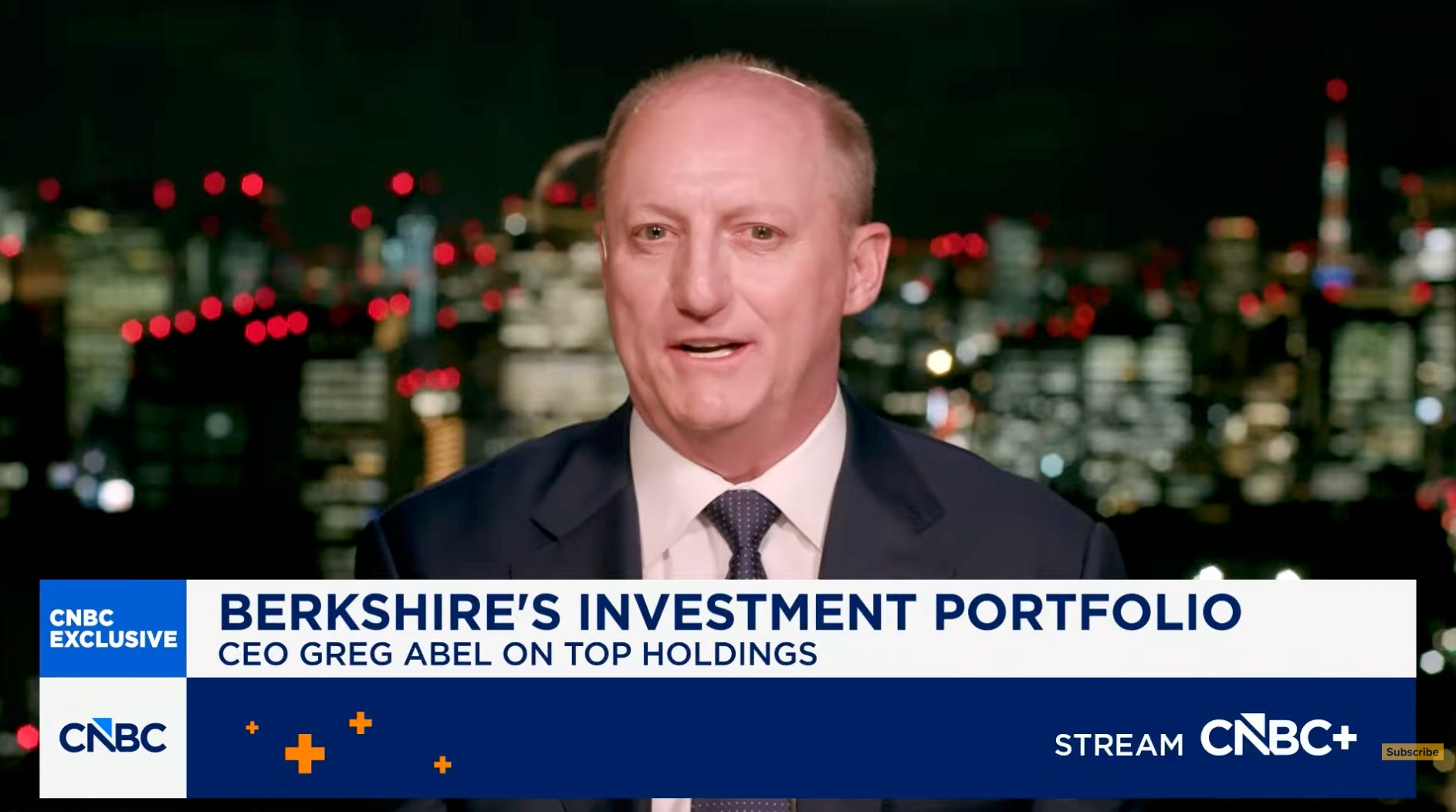
In this interview, he touched on such topics as Berkshire’s growing bet on Japan, the recent Alphabet investment, the AI-fueled (and controversial) data center buildout, his working relationship with Warren Buffett, what the Taylor Morrison acquisition says about the future of the housing market, and much more.
The full interview is well worth a watch, but (in the interest of time) I’ve collected nearly forty of Abel’s most memorable lines and comments down below.
On his relationship with Warren Buffett…
(1) “Warren turned 96 on Sunday. Before I left to come to Tokyo, [I] stopped in and had a great celebration with Warren [and] his family and friends. We had a very nice afternoon.”
(2) “Warren absolutely loves the Japanese companies we’re invested in. I could tell it wasn’t easy for Warren that off I went to Tokyo [without him].”
(3) “We have a great working relationship. We discuss a variety of things on a regular basis. It’s very much a dialogue we’ve always had. We love talking business. We love talking about what we’re seeing across our portfolio.”
On Berkshire Hathaway’s investment in the Japanese trading houses…
(4) “It’s really, one, a long-term investment that we intend to hold for many decades. And, secondly, we’ve been building really strong relationships with each of the companies and looking at other opportunities here in Japan and, for that matter, abroad.”
(5) “Those are just exceptional discussions that, each visit, we continue to build on the prior discussions and look at incremental opportunities.”
(6) “[Our investments in the sogo shosha] go back to six years ago. We actually announced it [on] Warren’s 90th birthday. It was announced in Japan that we had acquired just over 5%. It was really a long-term proposition that we saw as a long-term holding.”
(7) “Three years later, we were here in Tokyo and we met with each of the companies. That was part of building the relationship because we were very pleased with the underlying investment. At that point in time, our investment percentage had clicked over 7% and the businesses were performing well. They were managing their capital well, purchasing shares back in, increasing their dividends, and their overall performance continued to improve.”
(8) “We [asked], ‘Could we go over 10%?’ Up to that point, we had always highlighted we would stay below 10% and only exceed it if the five trading companies agreed to [it]. Upon receiving their approval, we went above 10%. It’s really a long-term investment that we intend to hold for many decades.”
On Japanese interest rates hitting a three-decade high…
(9) “Not a single one of the trading companies raised [higher interest rates] as a fundamental challenge right now. They’re still relatively modest when you think about it. I think the 10-year just hit a 30-year high. It went right to 3%.”
(10) “We have a debt portfolio in yen that pretty much reflects the cost basis of our investments [in Japan]. The remaining life on that debt is a little more than five years. We still have a significant carry — the difference between the dividend and the interest we’re paying.”
(11) “We envision still raising debt, as appropriate, in yen.”
(12) “At the same time, we do see the underlying companies’ earnings performance growing. We see an increase in dividends [as being] likely over the coming years and continued share repurchases. Yes, there’s an incremental cost [with higher interest rates], but we do see nice increases in the underlying returning capital they’re delivering back to shareholders.”
On Tokio Marine…
(13) “Right before our annual meeting, we announced the transaction with Tokio Marine. It’s an exceptional opportunity because they are a great partner. We were absolutely thrilled to be able to reach an agreement with them, where we have 2.5% of the quota share of their book — what they’re underwriting; a 2.5% interest in the company; and a strategic partnership.”
(14) “That strategic partnership is very broad and either of us can bring [M&A] ideas back and forth to each other. There’s no obligation to act on it. But if it were to make sense — both for Tokio Marine and for ourselves — we’d love to pursue a transaction with them.”
On visiting International Metalworking Companies (IMC) unit Tungaloy…
(15) “Upon arriving, I was able to go visit Tungaloy. It’s one of our operating units based in Japan. It’s part of IMC, a company that makes tool bits. [I] spent the afternoon up in Fukushima with our team there. It’s really an amazing story.”
(16) “We acquired it back in 2008 and, over that period of time, really built a business from scratch. It came out of Toshiba, but [was] a relatively small company.”
(17) “Here’s a company that has just under $240 million of sales in Japan and an incremental $400 million internationally. [It’s] a very small group just doing remarkable things.”
On Berkshire’s ~$35 billion investment in Alphabet/Google…
(18) “Warren initiated that probably close to fifteen months ago. He initiated the initial purchases in Alphabet. We continued — or he continued — a variety of purchases.”
(19) “In late May, I received a call on a Sunday morning to see if we wanted to participate in their upcoming equity offering. No terms or amount were set. I said, well, I’d get back to them right away. I called Warren and I said we had a significant opportunity to continue to invest in Google with a significant block. They hadn’t set the size, but recommended that we consider $10 billion or more. Warren and I discussed the size. I recommended a 6.5% discount and we were comfortable with that. We went back to them and highlighted that we would be interested in a block on those terms — and then ultimately consummated the transaction.”
(20) “We all are seeing and feeling the impact of AI. We knew it was going to have a significant impact on America and businesses. We have a lot of visibility from within our companies as to how we’re using AI [and] what type of benefits it’s delivering — so that brought incremental interest. We saw Google as a significant player [in this].”
(21) “There’s a lot more to Google than [that] and why we like it — but those were the fundamental reasons as to why we took a serious look at Google and now have a significant investment in it.”
On Berkshire Hathaway Energy and AI data centers…
(22) “I’ve always had a strong view that energy would be the constraint [for data centers].”
(23) “We can produce the energy. It’s [more a question of] how long it would take to get the sites prepared and being in a position [where] they could serve the data centers.”
(24) “We still see [data centers] as a significant opportunity for Berkshire Hathaway Energy.”
(25) “If you look at Iowa, where we have a number of data centers, approximately 8% of our load came from data centers [last year]. We see incremental load coming on — both customers demanding it and what we can serve.”
(26) “We’ve really operated [with] some pretty basic principles right from the get-go — and we’ve shared that with each of the hyperscalers, our states, our governors, and our regulators. We are interested in serving these hyperscalers:
One, if there was no impact to the rates of our other customers. And, in fact, we’ve pretty much taken the approach that there has to be a net benefit to our customers.
The communities have to understand the impact on water. That has become much more manageable as they address that and use the technologies that are available to minimize water use.
Lastly, the communities have to be open to having the data center in their community. We very much believe that you have to be a welcomed member of the community. Now, that’s a decision the data center has to make — but we can encourage them to seriously evaluate the reaction from the communities.”
(27) “There is a lot more pushback [to data centers] in the communities across the U.S.”
(28) “We have not had any specific site rejected to date. We’re continuing to move forward on the various sites we have under construction. Our sites would be the energy infrastructure — not the data center site — but it has to be done on the terms and conditions I just highlighted.”
(29) “The narrative around [data centers] is so critical — and it continues to evolve. It really did start from the impact on rates and [the question of] were you impacting other customers? You can see they’ve moved on from that narrative. I would say the water narrative is very strong coming from the data centers and how they minimize the use.”
(30) “There’s a very strong narrative — at least in Iowa, where it’s still a strong farming community — when we see both the energy infrastructure and a data center put in place in an individual county or community [and] the tax relief, specifically on property taxes and also revenues that come into the county to support other services, schools, police, and fire. It’s very, very substantial. That equally has to be part of the narrative, to make sure people recognize the benefits that come with that type of development.”
On Taylor Morrison and Berkshire’s homebuilding ambitions…
(31) “We don’t see any type of immediate recovery or any type of hockey stick [in housing]. We did see, from Berkshire’s perspective, that it’s going to be a bumpy ride for a while.”
(32) “It was an important part of the discussions with Taylor Morrison — and the discussions I had with Sheryl [Palmer] — that when we looked at housing, specifically in North America, we were taking a very long-term view that the American dream will continue to exist.”
(33) “We’ve got a great leader in Sheryl, [who] brings great optimism. But, as we discuss it, we don’t envision a quick recovery there. But we do see an industry that we definitely want to be invested in — and we are invested in — for the long term.”
(34) “Five [or] ten years from now, [Taylor Morrison] will be a very strong asset for Berkshire.”
(35) “We are combining some of our operations from Clayton Homes. We had fifteen site builders over in Clayton Homes [and] they’re now joining the Taylor Morrison team.”
On the economy…
(36) “If you look across our businesses and our results through the second quarter, [it’s] very strong in our larger businesses — including our manufacturing businesses.”
(37) “You can see there’s still strong demand, but I think you do feel there’s a consumer who is still clearly feeling the pain and struggling and having to stretch a lot further with their dollar. I think that does exist. There’s no question when we look at the underlying results.”
(38) “But, at the same time, the fundamentals around the economy — at least from what we’re seeing through the second quarter — remain very, very strong.”
Imagine being one of the few lucky guests joining Buffett to celebrate his birthday.
Then imagine that not only are you a guest, but you're also his protégé.
I think as time goes on, Greg will show everything Warren has taught him over these decades.