
One of the unexpected perks of Warren Buffett’s retirement is that he seems far more willing to sit down for interviews than at any other point in recent memory. By my count, CNBC has already aired four this year alone. Long may that continue.
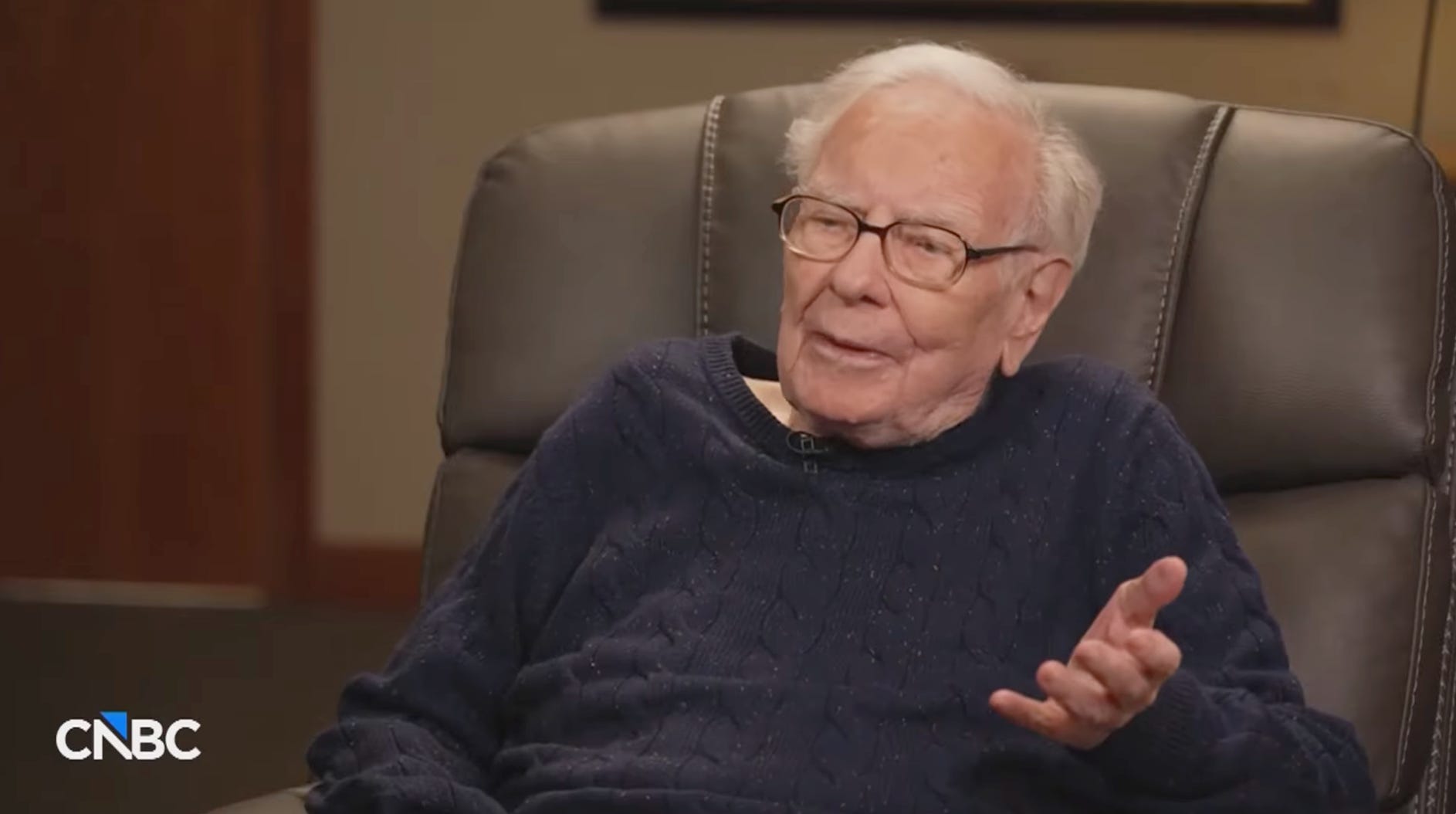
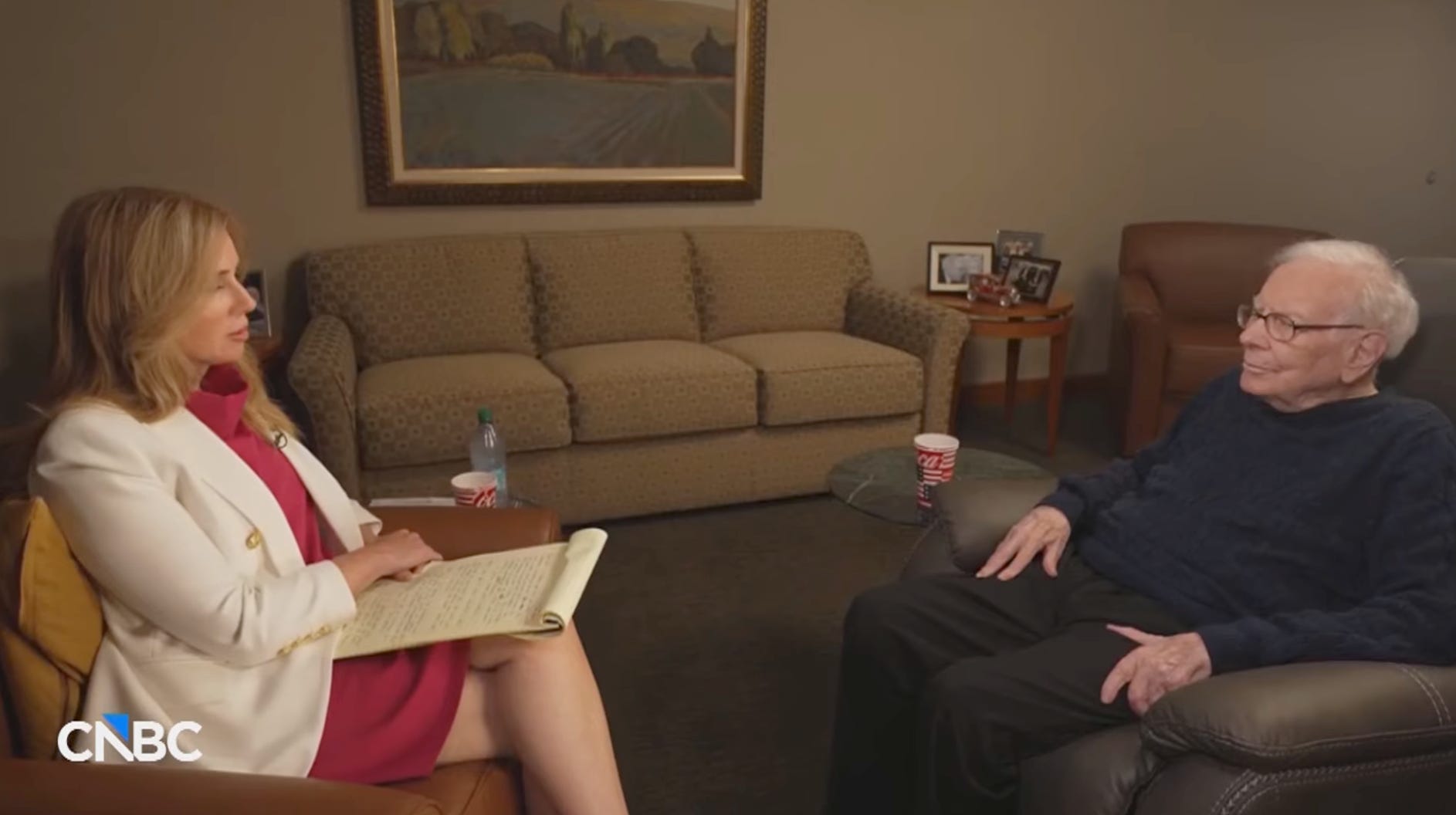
Buffett welcomed Becky Quick and crew back to Omaha last week for a wide-ranging, nearly hour-long conversation. The official occasion was his annual donation to four family foundations — and the conspicuous absence of the Gates Foundation from the recipients list — but he also proved characteristically candid on a much broader range of topics that Berkshire Hathaway shareholders will surely want to hear.
The full interview is well worth a watch, but (in the interest of time) I’ve collected fifty of Buffett’s most memorable lines and comments down below.
On Berkshire Hathaway’s ~$30 billion investment in Alphabet/Google…
(1) “I initiated [our Alphabet investment]. I normally wouldn’t give you an answer on something like that, but I am not doing anything that [Greg Abel] doesn’t approve of. He’s not doing anything I don’t approve of. We talk all the time — every day — but he is the decider.”
(2) “We are always making the choice between whether we will buy marketable securities or a company [in whole]. We look at them the same way.”
(3) “The real question with Google and all of its competitors now, they’re all laying out hundreds of billions. That’s real money. That kind of money wasn’t even put in the railroad business, in terms of developing it. That’s the game they’re playing now. They weren’t playing that game with computer software.”
(4) “I made a mistake [not investing in Google when it was an asset-light company].”
(5) “I think [Google] is more likely to be a winner based on the record than probably 95% of what gets merchandised through Wall Street.”
(6) “I would say that I don’t like [Google] as well as at least four or five other businesses that we own.”
(7) “[The hyperscalers] are now playing a game they don’t want to play.”
On Greg Abel succeeding him atop Berkshire Hathaway…
(8) “Berkshire, that’s my painting. And I like the painting. I like the people associated with it. It’s been refined over time. I have added an apple over here [to it].”
An excellent bit of wordplay from the Oracle here.
(9) “I don’t know of ten people in the United States who I would trust to hand [Berkshire] over to. I don’t know of five people — and I know a lot of people. I have a very high standard in terms of what I’m looking for in that person. And, clearly, we have found him with Greg Abel. That becomes more evident by the day.”
(10) “The only question is [Greg] is not immortal, either. You always have this mortality question and nobody gets away from it. People can be in marvelous health — or seem like it — [and then suddenly die]. There’s an enormous variation from being lucky to not being lucky.”
(11) “That’s the bet I make with Greg. I do not have a list of ten [possible replacements]. I don’t have ten kids, either. I don’t even have a list of three.”
(12) “I have got directors that I trust to be imbued with the concept of Berkshire Hathaway — and they would like to keep it going. So I’ve got the right group that’s the intermediary in making that choice. But things don’t always work out perfectly in the world.”
(13) “I’m losing marbles at this point. (Laughs) I accumulated marbles for a longer time than I deserved. That’s just a matter of luck. I have seen so many managers of our companies that [lost their marbles]. I think I have mentioned it in a few annual reports or annual meetings — we had guys cutting out paper dolls and their assistants [were] covering for them.”
(14) “I feel 100% [confident in Greg Abel]. I’ve seen him in a lot of situations. I felt that way with Charlie. I felt that way with Tom Murphy. But, you know, nobody expects you to pick out 25 husbands and have them all work out. Just finding one is pretty tough.”
On intelligent investing…
(15) “The important thing is to buy a good business and to buy it on the right terms and to get the right person to run it. When I say a very good business, I mean something that you can expect to earn high returns on capital over a long period of time.”
(16) “I can put huge amounts of money in government bonds and get $20-30-40 billion a year in terms of payments from them. So a good business is one that earns a lot more — and has prospects of continuing to earn a lot more — than the returns on essentially risk-less investments, which you could define as Treasuries.”
(17) “The trick in investing is to find businesses that are going to earn high returns on capital for an extended period of time. That’s what happened with Berkshire. A long period of time gets to be very important because those doubles later on are of very big numbers.”
(18) “Charlie Munger, my partner for many decades, just pounded the idea that it wasn’t a good business just because it was doing sexy things.”
(19) “I can’t recall a report on Wall Street that really gets into the internal rates of return that a business is actually earning. What’s more important than what a business is earning? But they ask all these questions about what will happen next quarter. It’s just ridiculous.”
(20) “If you have a wonderful business, you are going to be subject to attacks. It’s not a question of whether it was wonderful yesterday. The question is how long is it going to be wonderful?”
(21) “Wall Street thrives on convincing you that if you listen to them, they’ve got something that nobody else has. Which can’t be true. It’s ridiculous.”
On Apple, Tim Cook’s retirement, and the tech giant’s lawsuit against OpenAI…
(22) “There was no move [Apple] could make to replace Tim that I would have liked. (Laughs) If you’ve got Stradivarius playing the violin for you, don’t spend the next 300 years looking for another one. You have got one already.”
(23) “I know more about Apple than I knew many years ago. But, on the other hand, if you’re Apple, you have got very, very smart people all over the world shooting [at you] and trying to figure out how to make sure that Apple’s future isn’t as bright as in the past.”
(24) “Most companies would love to try to steal trade secrets. They wouldn’t love getting caught. But if you really could dig deep into the hearts of managers, they’d like to steal secrets. Wouldn’t you, if you had a business and you were struggling along and the guy next door was making money?”
On the speculative nature of today’s stock market…
(25) “There are times when opportunities are just thrown at you so fast [that] it’s unbelievable. And then there are other times when you’re very, very lucky if you find one thing in a couple of years.”
(26) “It’s tough to find values when everybody is preferring gambling.”
(27) “People’s enthusiasm for gambling is enormous.”
(28) “Since humans love to gamble so much, there’s more money in cultivating gamblers than there is in cultivating investors. If somebody bought Berkshire [stock] 40-50 years ago, a guy would have made one commission. And he should have spent the rest of his time telling the client, ‘Don’t do anything with it!’ And that’s just not the way [it goes]. We can’t expect that of humans. But, every now and then, you do find people that behave far better than other people.”
(29) “From the standpoint of the state, [legalized gambling] is sort of disgusting. The state needs money for all kinds of things — roads, schools, you name it — and they have found that they can clip people who are buying nothing but hope.”
On Coca-Cola’s $20 billion tax battle with the IRS…
(30) “I’ve got a dog in that fight, so… (Laughs) That’s why we have courts. Paying the extra money won’t break Coca-Cola any more than anything I can think of would break Berkshire. I mean, look, all I do is think about the downside. The upside will take care of itself.”
On management…
(31) “You either have happy customers or you don’t have [any] customers over time. And the customers are not dumb. Wall Street can be very dumb.”
(32) “Henry Ford owned the car business for 20-25 years and he brutally integrated like you cannot believe. He drove costs down. He got the cost of the Model T down, I think, to $285. He was always decreasing prices while increasing wages. He also was a little nuts in some ways — and that did him in finally when he converted over the Model A and General Motors just came racing by. My friend Charlie Munger thought that General Motors was going to be the dominant company. Who could imagine attacking their dealer fleet and everything they had going for them? [But] you’ve always got somebody shooting at you.”
(33) “I had a half-interest in a Sinclair filling station at 30th and Redick in Omaha when I was in my early twenties. I had been to business school and knew all these things. The guy next door had the Phillips station and was pumping 30,000 gallons a month. We were pumping 15,000 gallons a month. I said, ‘We’re going to wipe this guy off the face of the earth.’ And, a couple years later, we were selling 15,000 and he was selling 30,000 — and we gave up. I think he’s still operating. People are playing for keeps in business.”
On luck and gratitude…
(34) “Out of eight billion people, I may be one of the ten luckiest in the world. I’ve been lucky and healthy to get to 95. I’ve been lucky in that the field that intrigued me and where I had some natural ability, happened to be one that paid off in a way like nothing [else].”
(35) “Fortunately, I got exposed to what I liked to do very early on. That was just an accident. If my father had been a plumber, I would not have had the same advantage I had.”
(36) “America has been a wonderful place to invest money. The Dow Industrials, when I bought my first stock, had just crossed 100. Now, it’s 52,000 or something — and you have got dividends in between. The village idiot could have made it from that point forward, so I have been in the right game.”
On Federal Reserve chairman Kevin Warsh…
(37) “I think he was a good choice.”
(38) “I admire him for taking on the job. I think he will do the best he can at achieving the job he was assigned to do — which is 2% inflation while maintaining maximum employment.”
(39) “He knows he can’t be perfect at it. Just like I knew I couldn’t be perfect at taking people’s money and earning super returns on it. But my guess is that people were right in realizing that I cared about what happened to their money — and I would say that Warsh cares about the country.”
On Bill Gates & The Gates Foundation…
(40) “I have read [Bill’s] remarks to Congress given under oath and I read the cross-examination. And, while it’s distasteful, while he made mistakes, I [have] made mistakes in hiring all kinds of people or choosing friends and then finding out later that, one way or another, they weren’t what I thought they were.”
(41) “I have had situations where I made mistakes about people — or people may have felt they made mistakes about me — but life goes on.”
(42) “No one bats 1.000 in the business of choosing people.”
(43) “[Bill] came by almost three weeks ago — I lose track of time — and we spent three hours talking together.”
(44) “I don’t know whether I have done dumber things [than Bill’s association with Jeffrey Epstein], but I have done many dumb things in life. All I have to do is look at our portfolio. I mean, at least four out of five of the decisions I have made have not been anything out of the ordinary.”
On philanthropy…
(45) “My idea and conviction was that I would compound money at a better rate than society generally and that [my first wife] Susie would give it away better than 99.9% of the people who were giving it away. She would get involved personally with the gifts. I like to do things wholesale and she liked to do things retail.”
(46) “I admired [my dad] more than anybody in the world, but it still didn’t mean that I joined his church or did anything identically. And he encouraged that view. He would quote Emerson to me, where Emerson said something to the effect that the force in you is new in nature. You’re one of a kind. Find out what that one is. I found it very young, [but] my kids did not. They behaved like most kids. They flirted with a lot of different ideas. But I feel 100% now about what I have seen them do [that they are ready to give away my money].”
(47) “I tell the three children that it’s their responsibility to get it done well. You may find this hard to believe, but it’s true — I have never looked at their Form 990s, which they file. I’m not judging each action as it takes place because you take actions where you think there’s only a 10% or 20% probability of success. It’s not like investing.”
(48) “The money was important in terms of what it could actually do for other people. It wasn’t important for what it could do for me. I have not denied myself anything in life.”
(49) “I felt the most important threat to mankind was the nuclear bomb. I had sort of grandiose plans in my mind about how I could change the probabilities of that happening — and I finally came to the conclusion, after decades, that I could not have a hundredth or a thousandth of one percent chance of succeeding in that.”
(50) “You can’t mandate [philanthropy]. It isn’t philanthropy if you mandate it. But most people are a combination of lots of good instincts and lots of not-so-good instincts. Including me. If you do things that appeal to their better instincts, they respond. Sometimes.”
Not sure what to make of the way he frames the Alphabet buy. He admits it's not a top three position but it's still significant. Maybe he's just being coy about it deliberately, but he doesn't exude a sense of confidence about it. Despite his comments about downside in the interview, Alphabet does seem to be one with a notable downside if they are wrong - albeit that's just my take.
Josh Kerr sets world record in the mile wearing Brooks’ shoes. He predicted months ago he was going to break the 27 year-old record at this particular Diamond League event in London. Most found the prediction to be a bit brazen.