
Berkshire Hathaway CEO Greg Abel keeps a relatively low profile — so any time we get a glimpse at how he leads and interacts with the subsidiaries, I try to be all over it.
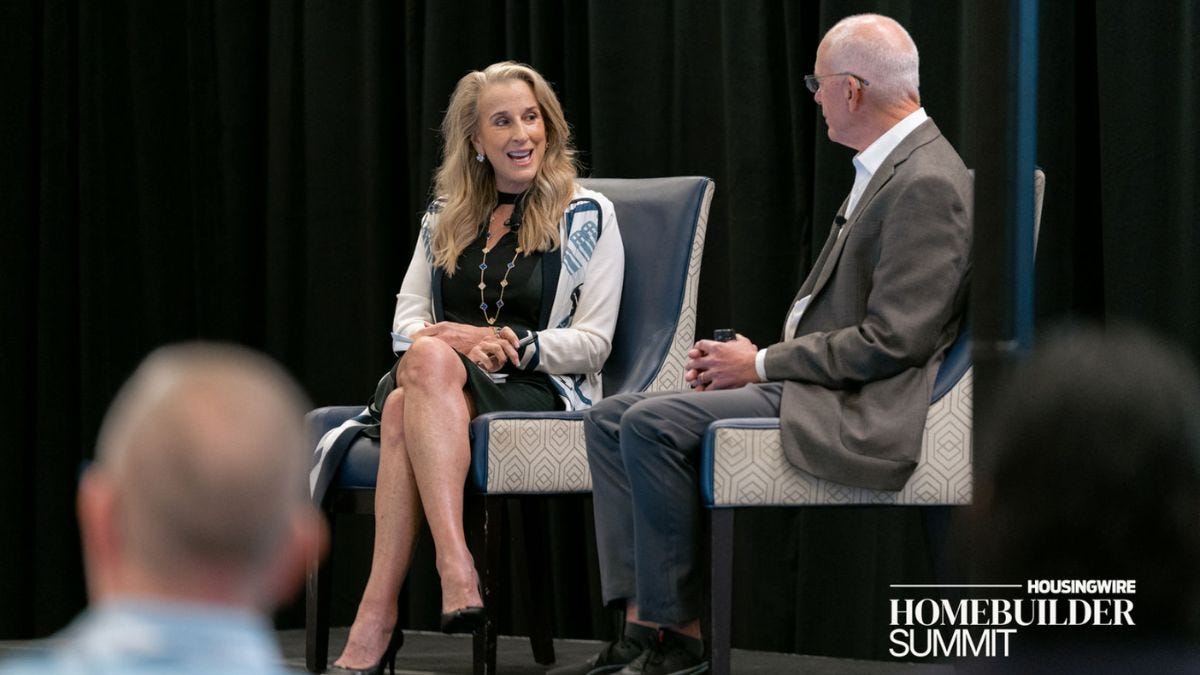
This one comes from Sheryl Palmer, CEO of Taylor Morrison, who shared what Abel told her after Berkshire acquired the homebuilder this summer.
“You get to do exactly what you’ve been doing,” she recalled Abel saying. “Run a responsible, good business — but you get to do it with real patience and a long-term lens. Don’t make any decisions for next quarter. Don’t even make decisions for next year. Do what’s right for the business as far out as you can see.”
A positively Buffett-esque sentiment from the new guy.
Palmer also used the HousingWire Homebuilder Summit stage to deliver a harsh truth to her industry. Over the past few years, builders essentially trained buyers to expect a panoply of incentives, mortgage rate buy-downs, and other perks. The longer a house sat on the market, the bigger the goodies got. And buyers certainly took notice.
Soon, she said, it will be time to wean them off these margin-eroding promotions.
“We, as builders, created this environment. We created this place where the longer the house has been sitting there, the more we’re going to give you.”
Palmer’s prescription: “We have to gain the courage back to sell [homes] based on the strengths of our community and our product.”
More news and notes from the Berkshire Hathaway orbit…
Berkshire Hathaway sold 382,563 shares of Davita for $69 million earlier this week. While the filing does not explicitly mention the Share Repurchase Agreement between the two companies, this sale almost certainly stems from it. Per the terms of that arrangement, Berkshire promises to keep its ownership percentage at or below 45% of the dialysis provider’s outstanding shares. DaVita bought back 600,000 shares of its own stock in the third quarter (plus another ~500,000 in October), necessitating this latest trim. Berkshire’s stake now rests at a carefully calibrated 45.0%.
A New Jersey bankruptcy judge approved a $535 million settlement involving Berkshire Hathaway’s insurance unit and Whittaker Clark & Daniels. Nearly two decades ago, National Indemnity Co. purchased the defunct talc supplier for a nominal sum and assumed its liabilities. In 2023, Whittaker entered bankruptcy after a “deluge” of lawsuits alleged its talc products contained asbestos and caused cancers.
(Neither Berkshire nor any of its subsidiaries had a hand in the manufacture or sale of the products that created these liabilities.)
The settlement drew objections from some plaintiffs as being insufficient, but the judge found it fair and reasonable. Berkshire already booked a $490 million pre-tax charge for this two years ago, with the remaining bit to be paid by third parties.
Warren Buffett and Charlie Munger did not agree on everything. Case in point: the sticky subject of inheritance. On the latest episode of his podcast, David Senra recounted a memorable moment from a dinner he had with Munger just a few months before his death. He asked Munger whether wealthy founders and investors should leave the bulk of their money to their children.
[Munger] goes, “You give them the money.”
I go, “Why?”
“Because they’ll hate you if you don’t.
What’s the point of building a relationship [with them] and making all this money and then, at the end of your life, your kids hate you?”
That was his very simple way of looking at this.
The ongoing railroad merger saga has served up a few new twists and turns. Earlier this year, Union Pacific CEO Jim Vena spoke at the Southwest Association of Rail Shippers meeting — and allegedly made “a thinly veiled threat to raise rates for customers who did not publicly support the merger”. UP says it was just a joke taken out of context and has fought to keep the footage under wraps ever since.
No dice. Late last week, an administrative law judge ruled that the video must be made public by today — which leaves Union Pacific a narrow window to appeal the decision to the Surface Transportation Board. If there is any truth to the rumors about Vena’s comments, it might encourage more shippers to speak out against the merger.
Meanwhile, Union Pacific also asked to subpoena documents from BNSF Railway parent Berkshire Hathaway and to depose both Warren Buffett and Greg Abel about their August 2025 meeting with former CSX CEO Joseph Hinrichs.
The judge put both requests on hold for now.
Coca-Cola says it’s ready for whichever way its IRS case breaks. I won’t bore you with all of the details, but the dispute centers on transfer pricing and whether or not Coke kept too much of its profits in overseas subsidiaries in order to pay less tax. It has already paid $6 billion in back taxes and could be on the hook for another $14 billion if its appeal to the Eleventh Circuit fails. Not exactly chump change.
“We’re anticipating a decision in the coming months in the IRS case,” Coca-Cola president John Murphy said this week. “At the same time, we continue to think ahead as to the various outcomes that that decision could generate and feel good where we are with respect to being able to manage a best and worst case scenario.”
Buffett touched briefly on this in his CNBC interview over the summer — and didn’t sound particularly bothered about an adverse outcome. “That’s why we have courts,” he said. “Paying the extra money won’t break Coca-Cola any more than anything I can think of would break Berkshire.”
Clayton Homes released a teaser for its documentary short film on the origins, evolution, and future of factory-built housing. Directed by Barrett Burgin and presented by Clayton, Built: A Story of Factory-Built Housing in America travels from the wartime boomtown of Oak Ridge, Tennessee, to the housing challenges of today.
“One of the most fascinating things I’ve learned while making ‘Built’ is how factory-built housing has played a role in some of the most innovative periods in our nation’s history,” said Burgin. “And yet, despite being around for generations, we continue to overlook its potential.”
The PC market is having a rough time of late, but Apple is bleeding less than almost everyone else. According to Counterpoint Research, global PC shipments plunged 21% in the third quarter, as climbing memory and component costs pushed prices higher and nudged shoppers to wait a while on that laptop upgrade. Apple wasn’t immune from the downturn, but its shipments slipped just 11% to 5.6 million units.
In a shrinking market, that’s good enough to gain ground. Apple’s market share rose from 8.7% to 9.8%, with the budget-friendly MacBook Neo providing an affordable counterweight to the rest of its more premium lineup. (Apple will reportedly release the second-generation Neo in the first half of 2027.)
Bending Spoons completed its acquisition of Miro, the virtual whiteboard that became a pandemic-era phenomenon when remote workers were eager to recreate the feeling of in-person collaboration. Miro’s user base exploded from 5 million to 30 million in just two years — and, at its peak, the company was valued as high as $17.5 billion. Bending Spoons landed it at a far more modest multiple, paying $1.36 billion in cash now that the appetite for remote-work tools has cooled.
Still, Miro is no fixer-upper. It counts more than 100 million total users, over four million paying customers, and roughly $600 million in annual recurring revenue.
“Miro has built a strong business around a product that makes complex collaborative work feel simple,” said Bending Spoons CEO Luca Ferrari. “We believe there’s significant potential to build on those strengths.”
Miro co-founder Andrey Khusid hailed BSP 0.00%↑ as “an owner who invests for the long term and cares deeply about product quality.”
In other Bending Spoons news, the software conglomerate announced plans to offer $1.8 billion in dual-currency senior secured notes to fund future acquisitions.
On the lighter side… Even the sharpest minds start out a little awkward. In 1991, Charlie Munger returned to Omaha for his 50th high school reunion and treated his former classmates to the story of one of his first dates.
Young Charlie was determined to come across as a sophisticated man of the world, so he dipped into his pocket, pulled out a cigarette, and lit up — even though he was not actually a smoker. The result was less James Bond and more slapstick disaster. “Unfortunately,” he laughed, “I flicked a hot ash on her dress and set it afire.” 🤣
Small detail from the Form 4 for anyone tracking the DaVita trim: the 382,563 shares went at an average of $180.43 on Oct 27, and Berkshire reported 28,314,666 shares afterwards. Per the footnotes, about 13.3M of those sit at GEICO and the other ~15.0M in the BNSF and Berkshire pension plans.
The Taylor Morrison detail stood out: Abel telling a new CEO to make no decisions for a quarter, or even a year, and focus on the long term is pure Buffett playbook. Which Berkshire business do you think will be the first real test of whether that hands-off approach holds up once Abel faces a rough stretch?