
Every few years, someone announces they’re building the next Berkshire Hathaway. Bill Ackman, it’s fair to say, is taking this idea further than most — investing heavily in Howard Hughes Holdings with an aim to make it the “modern-day” Berkshire.
On this week’s episode of The Knowledge Project podcast, Ackman shared the aspects of Berkshire that he hopes to emulate with his investment vehicle and the inspiration Buffett’s example provided to his own life and career.
I’m not terribly invested (in any sense of the word) in what happens with Howard Hughes, but did want to highlight a few of Ackman’s more interesting comments.
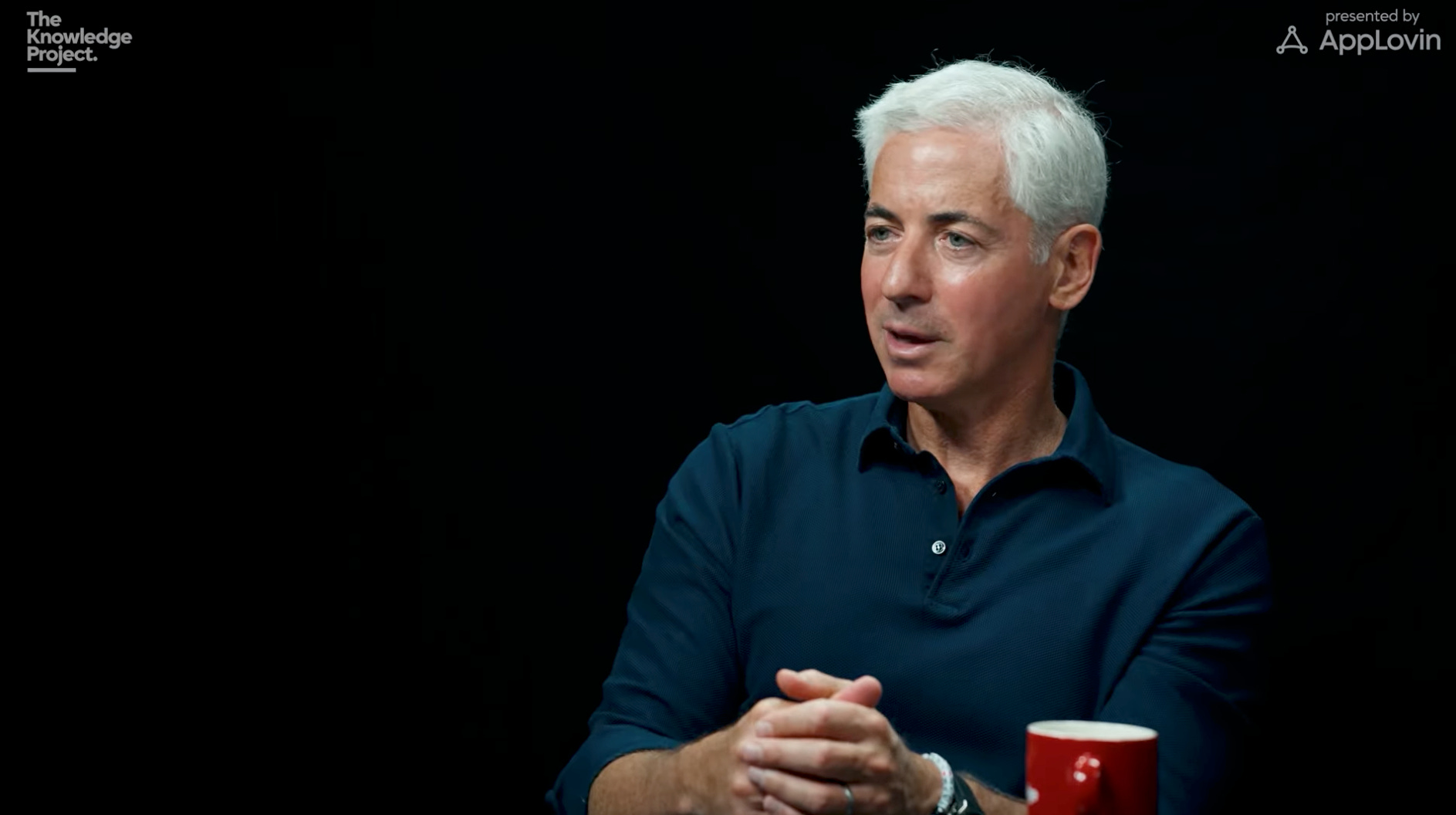
The engine under Berkshire’s hood. “The driver of the value of Berkshire Hathaway over time is its insurance operation,” said Ackman.
“When Buffett talked about buying Coca-Cola or American Express or other companies, those were assets purchased in the insurance company.”
Which, oddly enough, explains why Berkshire attracts so few imitators.
“It’s not sexy to be in the investment operation of an insurance company,” he said. “I think that’s a large part of the reason why people don’t do this.”
Buffett’s modest $100,000 salary — when he could have commanded (and received) much more — paid off in other ways. “His willingness to ‘work for free’ in effect was a very helpful thing to the ethos around Berkshire,” said Ackman. “It probably made negotiations around compensation for other employees easier.”
When the boss sets the tone on pay, everyone else has a hard time arguing for more.
Host Shane Parrish relayed something Charlie Munger once told him. The most underrated part of Berkshire’s success was that circumstances never forced its hand. Berkshire always had options — and could afford to focus on the long run.
“[Buffett] could take a long-term view,” Ackman agreed. “He wasn’t exposed to the short-term whims of his shareholders.”
He then connected this to the advantage of permanent capital, which allows that kind of long-term mindset in both good times and bad.
“One of the very smart things Buffett did is he decided at a certain age how he wanted to live his life,” said Ackman. “He didn’t want to live a life dealing with constantly raising money — which is what you have to do if you’re in the hedge fund business.”
“In the hedge fund business, when you do really well, institutional allocators take money away from you because you’ve become too big a percentage of their portfolio. [And] when you have a bad period, people take money away from you because you’re having a bad period.” It can be tough to build for the future on such shifting ground.
More news and notes from the Berkshire Hathaway orbit…
Berkshire (still) loves Lennar. Over the final six trading days of September, it added 2.34 million more shares of the homebuilder at an approximate price of $190.3 million. This latest shopping spree pushes Berkshire’s stake in the company up to 11%.
Apple’s new CEO wants the tech giant to move faster. John Ternus reportedly plans to run a tight ship, cutting the layer of middle management that sits between engineers and senior executives and getting new products out the door more quickly — even if that means ditching Apple’s traditional spring and fall release windows.
None of this should come as a shock to anyone who’s worked with him in the past.
Ternus has advocated for a leaner organization for years. While leading hardware engineering, he told employees during an all-hands meeting that Apple should hire fewer people, ask more of its existing engineers, and reduce organizational bloat. During a presentation, he showed a slide charting annual headcount growth and argued that the company should be accomplishing more with fewer employees.
A few more bits of Apple news:
The iPhone 18 Pro series got off to a roaring start in China. Weekly sales figures (which only included the first three days after the 18 Pro’s release) grew 12% over last year and lifted Apple into the top spot with 33% market share. “Price hikes of over $200 on many Chinese flagship models may have raised the price anchor,” said Counterpoint Research senior analyst Ivan Lam, “strengthening the iPhone’s relative value proposition.”
iPhone Duo may be facing production problems ahead of its launch later this month. Jiemian News reports that final assembly yields for the foldable were just slightly north of 60% as of a few weeks ago. In other words, roughly four in ten devices rolling off the line don’t make the cut. Expect tight supply early on.
Apple got socked with $5.7 billion in damages after a federal jury determined that it had infringed (though not willfully) on Taction’s haptics patents. “Apple’s Taptic Engine is fundamentally different from Taction’s technology, which Taction’s own testing of Apple’s products confirmed during trial,” the company told CNBC. “Apple does not use Taction’s technology — and we will appeal.”
BNSF Railway just wrapped up three capital projects that add capacity across its network. In Galesburg, Illinois, the Berkshire-owned railroad added a second parallel lead track at the hump yard — which could result in 250 additional railcars processed each day. Out in Winslow, Arizona, new track lets crews do power modification work on the Southern Transcon without blocking the mainline.
Most interesting are the three new receiving and departure tracks in Memphis, Tennessee. A project that was not originally in BNSF’s annual capital plan. “Volume growth with existing customers and new long-term business opportunities materialized quickly in 2026,” said COO Craig Morehouse, “[so] we adjusted to accommodate our customers’ needs.” Seems like a bullish sign for freight demand.
Imagine a data center with no walls, no power bill, and a sun that never sets. That’s the idea behind Google’s Project Suncatcher, a long-term research moonshot asking whether the next generation of AI infrastructure could live in orbit. Yesterday, that dream got its first real test: a prototype satellite carrying Google’s Tensor Processing Units (TPUs) launched into space aboard a SpaceX Falcon 9 rocket.
There, in low Earth orbit, satellites bask in near-constant sunlight, collecting up to 8x more solar power than a panel on the ground. But space can be a brutal place to run a computer. The prototype will spend the next few months testing how these TPUs handle the violence of launch, punishing radiation, and cooling with no airflow.
NetJets goes big in Texas. Just a few weeks after plans surfaced for an expansion at Dallas Love Field Airport, the world’s largest private jet operator also filed paperwork with the Texas Department of Licensing and Regulation for a new private terminal near Austin-Bergstrom International Airport. The 8,000-square-foot facility will cost an estimated $19.5 million and should be open for business in June 2028.
Tokio Marine may — or may not — be in takeover talks with Australian insurer Suncorp. The Australian reported earlier this week that discussions between the two companies were already serious enough that a delegation of Suncorp executives — led by CFO Jeremy Robson — had traveled to Japan. But, in response to an Australian Securities Exchange query, Suncorp said that it’s not in discussions regarding any potential takeover and that it had not even received an offer. Stay tuned.
According to sales data from Circana, childless adults are now buying more toys than parents with kids. Jazwares president Jeremy Padawer — who himself keeps about 25% of his net worth in collectibles and, notably, lost a $4.5 million Pokemon card collection in the Palisades wildfire — told the New York Post that this shift is no fluke. “Today, the adult collector dominates the market. That’s going to be a thread that we follow further in the future.”
Exhibit A: Squishmallows. The plush line was originally designed with young girls in mind, yet grew into an all-ages, TikTok-fueled obsession that has now sold more than half a billion plushes.
“If you go back 20-25 years ago,” said Padawer, “an adult collecting toys was like The 40-Year-Old Virgin. It was weird. Now, it’s cool to be a collector.”
You can see the evidence in plain sight. On Zoom calls, people proudly arrange toys and collectibles behind them like trophies. And Toys R Us, once a casualty of the changing retail landscape, is staging a comeback with 120 brick-and-mortar stores opening this holiday season. A toy renaissance is here — and adults are leading it.