
In recent years, Warren Buffett has marked the Thanksgiving season with a charitable gift and a message to Berkshire Hathaway shareholders.
And, on Monday, that tradition continued.
Buffett converted 6,150 of his Class A shares into 9.225 million Class B shares — worth roughly $5.5 billion — and donated them to four family foundations. This gift dwarfs last year’s $1.3 billion, which reflects his updated plan to move all remaining shares into these foundations by the end of 2034.
After this week’s donation, Buffett still holds 182,140 Class A shares and 1,162 Class B shares, giving him 29.6% of the voting power and 12.9% economic interest in Berkshire.
The letter that came with the gift is much shorter than last year’s. “You heard plenty from me in September about my confidence in Berkshire,” he wrote. “My confidence is as strong as ever, so I will keep this Thanksgiving message short.”
Unfortunate for those of us hoping for a longer read, but understandable.
What Buffett offered, instead, was a lesson from a different ledger. He has spent a lifetime showing how small, durable advantages compound into extraordinary results. This year, he turned that same logic toward people. Kindness, he wrote, compounds “and at a better rate than anything Charlie and I ever bought”.
He also pointed to three “teachers” who shaped his life: Benjamin Graham, Joe Rosenfield, and Tom Murphy. “Much of my good fortune,” said Buffett, “has come in the form of people who were kind to me and expected nothing in return.”
So, this Thanksgiving, he challenged readers to recognize those who played a similar role in their own rise. “Thank one of those selfless people in your own life,” he said. “Better yet, be a benefactor for someone else.”
Other items of interest from the Berkshire Hathaway orbit…
Two of Berkshire Hathaway’s newest senior leaders — CFO Chuck Chang and general counsel Michael O’Sullivan — added some skin in the game last week. Chang purchased two Class A shares for $1.78 million and O’Sullivan bought 421 Class B shares for roughly $250,000. If you do the math, you will see there’s no inside track here. Both men paid (with their own money) the market price, the same one available to any schlub with a brokerage account.
Even inner circle executives bet alongside shareholders, not ahead of them.
These purchases came a few days after Berkshire’s Q3 2026 earnings report. Chang and O’Sullivan bought shares in a similar fashion back in August after second-quarter earnings, so this looks like it might become a quarterly habit.
Smart employees notice what their boss does — and Greg Abel has publicly committed to spending 100% of his salary on Berkshire shares each year. That kind of leadership has a way of trickling down the organizational pyramid.
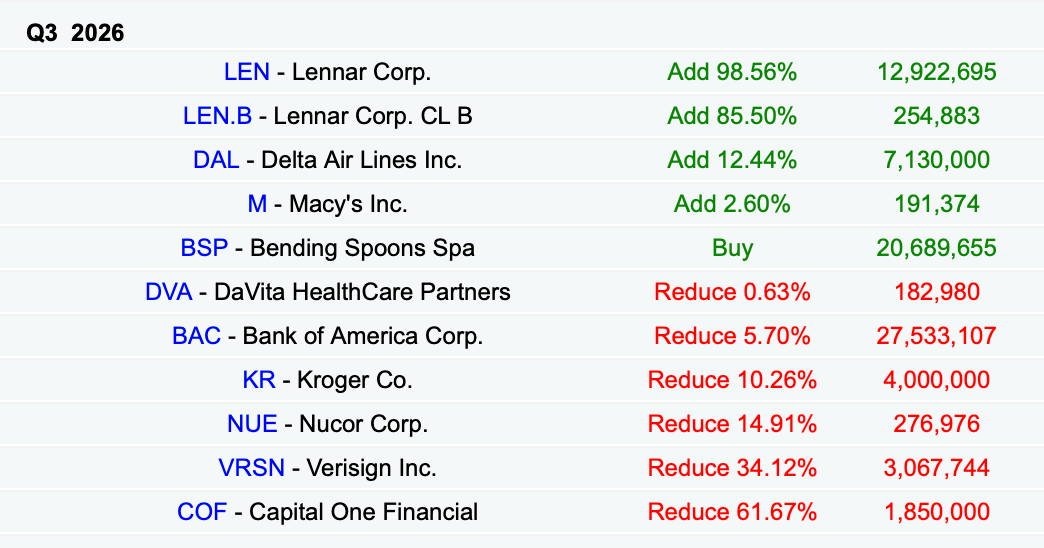
Berkshire’s 13F was every bit as uneventful as expected. Most of the headlines had already surfaced in earlier regulatory filings, including the purchases of Lennar and Bending Spoons and the trimming of DaVita.
Berkshire sold some Bank of America stock for the ninth straight quarter, but even after all that selling it still remains the fifth-largest holding in the portfolio.
If Berkshire’s recent investment in Bending Spoons, the Milan-based digital conglomerate, left you scratching your head, this interview with CEO Luca Ferrari might set your mind at ease. Last month, he sat down with the Joys of Compounding podcast and really dove into the company’s aims and operations. I was struck by how fluently Ferrari speaks the language of Berkshire — and how Abel (or whoever made this investment) could see him as a kindred spirit.
The full interview is well worth a listen, but here are some of the highlights:
Bending Spoons installs its own technology platform at each new acquisition, but the overall model leans heavily towards decentralization. “We sometimes joke that we buy established companies and we bring them back to startup mode,” said Ferrari. “And we really do. These small talent-dense teams with massive mandates to just go and get it.” The teams receive a standardized toolkit and technological foundation, but then make 99% of all future decisions themselves.
Ferrari does not apologize for his company’s penchant for downsizing new acquisitions. “I’d like to think that with Bending Spoons, we can reset the bar for what it looks like to run a business optimally. I know that it’s controversial because we often part ways with many team members of acquired companies. I do believe that the world is a better place if businesses are run exceptionally well, even though there are sometimes disruptive, painful short-term consequences.”
Bending Spoons *really* does not worry about organic growth in its owned businesses. “A majority of investors are focused on organic growth, even with Bending Spoons, which I initially found odd given that the entire value proposition here is that we want to be the ultimate — ideally, the perfect — M&A and operating machine.” Ferrari later called organic growth nearly irrelevant for the conglomerate and said he has no problem owning shrinking companies if the price is right.
If the future value of Bending Spoons depends on M&A, what happens if it runs out of companies to buy? Ferrari evoked legendary UCLA basketball coach John Wooden here. “[Wooden’s] definition of success was you have done 100% of what you could. I’m quite optimistic, but if I knew that there’s only another eight years runway and then there’s nothing else we can ever do again, it’s not a good reason not to go all the way for eight years to the best of our abilities. We can still have ten times the company — or hopefully even more. And then maybe we start paying dividends or, if the stock price is low, we can buy it back. Nothing is forever anyway. It’s not like it was a bad idea to build Google [just] because search couldn’t be an infinite business. At some point, it saturates.”
This interview took place before Berkshire had been revealed as a BSP 0.00%↑ investor, so that was not discussed. Many thanks to the kind reader who sent this interview my way!
And, while we’re on the subject, Bending Spoons announced last evening that it will acquire email marketing platform Mailchimp from Intuit in a $3.68 billion deal.
Recent insiders paying 1.65x most recent book value!