
(1) Berkshire Hathaway’s first annual shareholders meeting under CEO Greg Abel was less a dramatic changing of the guard than a confident affirmation of culture and continuity. Morningstar senior analyst Greggory Warren captured the feeling well. “Overall,” he wrote, “we think the first annual meeting without Buffett at the helm was a calm affair filled with confidence on the part of Berkshire’s managers that they have what it takes to move the company forward.”
Heading into the meeting, Warren noted that Berkshire stock was then trading at a 7% discount to his fair value estimate of $765,000 (Class A) and $510 (Class B).
Whitney Tilson sees an even wider gap between price and value. After crunching the latest 10-Q numbers, he revised his intrinsic value estimate upward to $822,000 (A) and $548 (B). “I’m especially bullish because in addition to today’s discounted stock price, I’m optimistic that Abel can create value via operational improvements and capital allocation.” That combination, he argues, makes Berkshire highly likely to beat the S&P 500 over the next five years — “perhaps by a margin of 2-3%”.
(2) Numbers tell one story. People another. The Omaha World-Herald offered an interesting glimpse into Greg Abel beyond the balance sheet — and his penchant for lunch at California Tacos & More whenever in town. “Greg comes into the restaurant quite often,” said owner Brad Bogard, “and it’s been a pleasure getting to know him.”
What Bogard noticed most, though, wasn’t Abel’s order — usually beef tacos or smoked spare ribs — but his manner. He called Abel “the perfect choice as Berkshire CEO” and described a man who treats every member of the staff with kindness and interest in what they have to say. As such, Bogard feels bullish about the future. “Greg will multiply Warren’s efforts [at Berkshire],” he said. “You take it from me.”
(3) Warren Buffett once said of Ajit Jain that if he, Charlie Munger, and Jain were all in a sinking boat and you could only save one of them — save Ajit. In other words, Berkshire’s vice chairman of insurance operations is pretty much irreplaceable. But, even so, preparations must be made for the 74-year-old’s eventual retirement.
The Wall Street Journal reports that Berkshire has designated Charlie Shamieh, chairman of Gen Re, as the heir apparent to Jain’s insurance throne. For his part, Jain “hasn’t signaled when he will step down” and “is expected to remain in the role for the foreseeable future”. Buffett himself told the Journal earlier this year that Jain would “probably … be at the company for as long as he can”.
Which, knowing his devotion to the business, could be quite a long time.
The Journal acknowledged as much, noting that if Jain’s tenure extends well into the future, Berkshire may consider other candidates that better fit the new timeline. But, at least for the time being, Shamieh is next man up.
(And, in a case of absolutely perfect timing, the just-released new 25th anniversary edition of The Warren Buffett CEO features a rare interview and profile of Shamieh.)
(4) In the days leading up to Berkshire’s annual meeting, new CEO Greg Abel made it crystal clear that he intends to lead the conglomerate for a long time to come. “My runway is really long,” he told CNBC’s Becky Quick. “I love doing this. I want our shareholders to know there’s absolute commitment and passion.”
Abel waved off any concern that family life and corporate leadership are at odds — framing the two not as competing obligations pulling in opposite directions, but as parallel sources of purpose. “I have a great family,” he said. “I prioritize my family and I prioritize Berkshire — and I know how to find the [right] balance.”
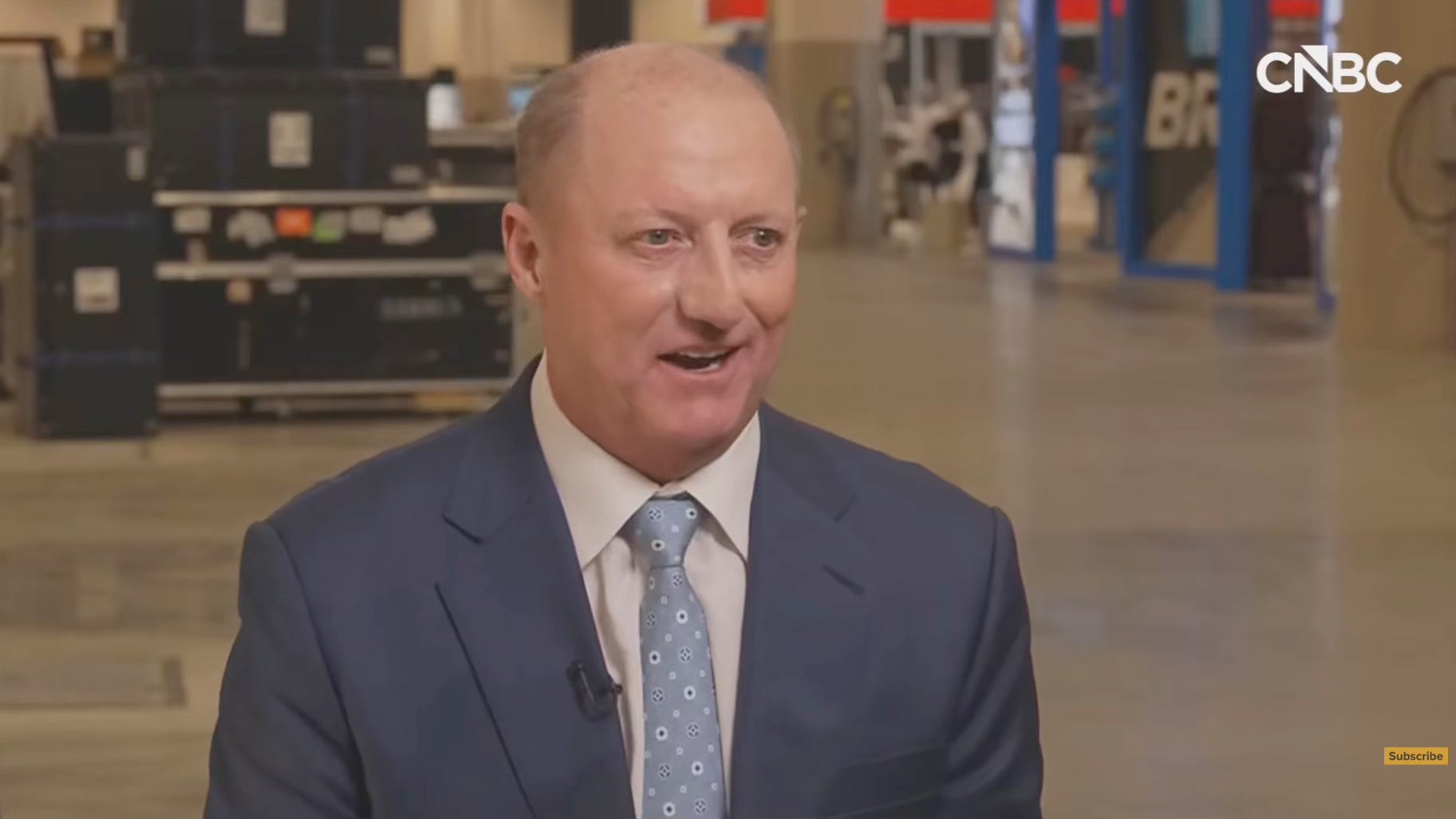
“When I said [I hoped to run Berkshire for] twenty years in the letter, that would not surprise me. But that’s up to our board, obviously, and our shareholders. We have to be doing a great job. I love Berkshire and I see myself in this role for a long time.”
(5) In the same interview, Abel also revealed plans to sit down personally with the incoming chief executives of two of Berkshire’s most consequential investees — Apple and Coca-Cola. (Henrique Braun recently succeeded James Quincey at Coke and John Ternus will take the reins from Tim Cook at Apple on September 1.)
“We know the quality of [both] businesses,” said Abel. “The boards are exceptional. They’re going to have thought this through very clearly and have the right leader. Time always tells, but the reality is we’re excited by the leaders coming in and very supportive of what the prior two leaders have done. It’s remarkable what they’ve done with those two businesses.”
Apple’s iPhone sales surged 22% in the first quarter. “We’re seeing double-digit growth across the markets we track,” said Cook on the earnings call, “and set a new March quarter record for upgraders, as well. What’s driving all of this is that customer satisfaction for the iPhone 17 family in the U.S. is 99%. These numbers are unheard of. We’re thrilled with how things are going.”
Under its new CEO, Coca-Cola sees artificial intelligence as “a superpower for us moving forward”. Not only has the soft drink giant used generative AI to produce its last two holiday ad campaigns — “at a fraction of the cost and way faster than we used to” — but also hopes to harness the data flowing through Coke’s vast global network of bottlers to identify better product and sales strategies.
(6) Brooks CEO Dan Sheridan is navigating what seems, on paper, as a double transition. The handoff from Warren Buffett to Greg Abel as Berkshire’s chief executive — but also a new reporting line to Adam Johnson, the incoming president of the Consumer Products, Service & Retailing group. But, in practice, the changes have barely made a ripple. “It’s been very consistent for us over the years in reporting to Greg,” he told Yahoo Finance, “and we anticipate the same thing [with Adam].”
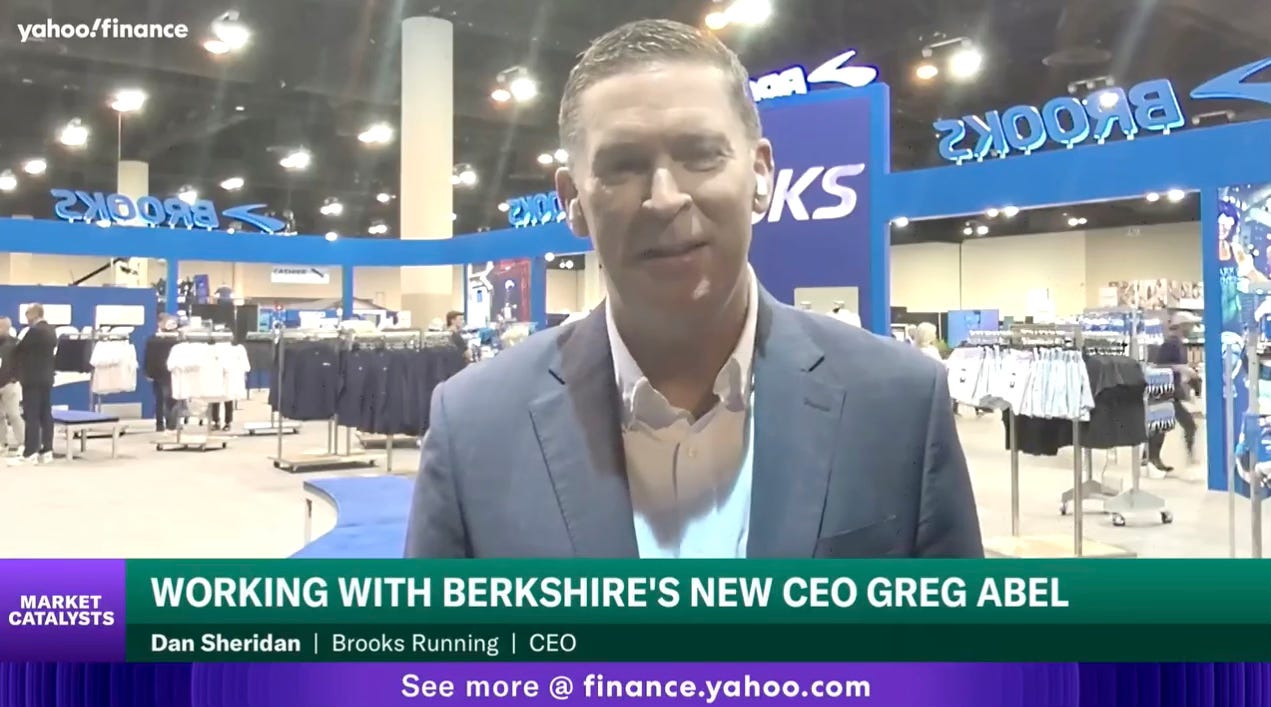
The through-line in all of this is Berkshire’s culture of deserved trust — the foundational principle that capable managers are given room to run their businesses without interference from Omaha and that the relationship between parent and subsidiary is built on confidence rather than oversight.
“Over the years,” added Sheridan, “Greg has been just a great partner to us at Brooks. Sage advice all the time you need it. Now, we’re transitioning to Adam Johnson — who I report directly to — and Adam has been incredible in his first few months here. He and I connected yesterday and I would say the exact same thing [about him] — very consistent leadership here at Berkshire.”
(7) Adam Johnson may now oversee the 32 members of Berkshire’s Consumer Products, Service & Retailing group, but he also remains the proud CEO of NetJets. And, at the AGM last weekend, he shared a handful of fun facts about the company.
Start with Augusta, GA, and the legendary Masters golf tournament. In a single week, NetJets operated more than 700 flights there. On that Friday alone: 140.
Then there is Teterboro and West Palm Beach, two airports that together account for 10% of everything NetJets does across the entire planet. “We fly out of 3,100 airports,” said Johnson, “and those two [are 10%].”
Zoom out further and the scale becomes difficult to process. Somewhere in the world, a NetJets aircraft lands every 57 seconds.
And the fleet to support it just keeps growing. “We’re at 1,104 airplanes worldwide right now,” said Johnson, “and taking [delivery of] a new airplane about every three-and-a-half days.”
(8) Berkshire Hathaway sold another 1.22 million shares of Davita last week — generating $182.9 million in proceeds and reducing its ownership stake to 44.9%. This is not a case of changing sentiment about the dialysis provider, but a result of the Share Repurchase Agreement between the two companies. When Davita buys back its own shares on the open market, Berkshire’s ownership percentage naturally rises — and these quarterly sales bring it back down below the agreed-upon 45% limit.
Elsewhere, two of the Japanese trading houses announced that Berkshire recently raised its ownership position above 10%. Berkshire’s stake in Marubeni increased from 9.32% to 10.10%, while Sumitomo jumped from 9.30% to 10.05%.
(9) After better-than-expected first quarter results, Kraft Heinz CEO Steve Cahillane sat down with CNBC’s Mad Money to discuss the company’s turnaround story. And it all started with his decision — possibly at Berkshire’s urging — to pause separation plans and refocus all efforts on growing the business.
“When I came in,” he said, “the company was very focused on the separation. When you take 36,000 people and redirect them towards a maniacal focus on growing the top line — not in separating the business — it’s amazing what you can achieve with that type of human capital.”
Cahillane traced Kraft Heinz’s troubles back to the 2015 merger and 3G Capital’s ruthless cost discipline. “Where the company missed the mark [after the merger] was that all the cost savings generated — which were quite substantial — flowed directly to the bottom line,” he said. “EBITDA margins went up to close to 30%, [but] there was not enough investment put back into the brands to attend to the top line.” He aims to rectify that by investing $600 million to boost North American sales.
(10) Happy trails to Occidental Petroleum CEO Vicki Hollub, who will retire next month. Her tenure will surely be remembered for big M&A swings like Anadarko (2019) and CrownRock (2024) — which, together, pulled Occidental’s portfolio from a sprawling global footprint into one overwhelmingly concentrated in the United States. Whether the debt load those deals required proves worth it remains open to debate, no one can ever accuse Hollub of not having the courage of her convictions.
Her successor, Richard Jackson, joined Occidental in 2003 and was named chief operating officer just a few months ago. He brings deep hands-on experience in onshore oil and gas operations and enhanced oil recovery — the technical disciplines that will likely define Occidental’s performance in the years ahead.
One more thing: Last night, Berkshire announced that retiring CFO Marc Hamburg will be given up to 30 flight hours per year on NetJets “in recognition of [his] many decades of service”. This benefit will be available to Hamburg and his wife until 2037. Berkshire estimates the cost (including covering the imputed tax) at $490,000 per year.
The new CFO’s cash comp is nearly twice Marc Hamburg’s salary last year, and from the meeting we know that Berkshire had to also hire a general counsel to replace Marc’s role. So the NetJets retirement benefit is really the least shareholders can do for him!
I have to question why Whitney Tilson is given space for his estimation of value. He's forever way high. If Buffett himself gives you a number as he has here then that's pretty much what you need to know. If you're looking for a Berkshire bull, stick with Chris Bloomstran who writes an annual novel in service to his computations. Otherwise, solid reporting. Thank you.