
Coming next week for paid supporters: I’ve pieced together all of the extant reports from the 1989 Berkshire Hathaway AGM — back from before the meetings were taped and transcribed — to give as complete a record of the event as possible. Absent a time machine, this is as close as we’ll ever get to being there that day. Upgrade now so you don’t miss out!
(1) Later this afternoon, Berkshire Hathaway will reveal its Q1 2026 investment activity via a new 13-F filing. Here’s what we already know: Berkshire sold $8.1 billion of common stock (net) in the first quarter, extending its streak as a net seller to fourteen consecutive quarters. But that framing only tells part of the story.
Berkshire’s continued net seller status somewhat obscures the fact that it laid out $15.9 billion during the quarter on new purchases. That represents a pretty significant amount of capital freshly deployed into the portfolio. A real statement of conviction after many quarters of relatively modest activity. And, in the space of three months, just slightly less than Berkshire spent on stock throughout all of last year.
(2) Nebraska Furniture Mart brought executives from Manwah — one of its key furniture suppliers — to Omaha for the Berkshire annual meeting. And the experience made a clear impression on company president (and first-time attendee) Gabriele Natale. “Warren Buffett has built something virtually unprecedented: a trust-based conglomerate,” he told Furniture Today.
“His philosophy — investing in people and businesses with ‘moats’ and long-term viability — is clearly the DNA of the organization. He didn’t just build a portfolio. He built a standard for corporate integrity and simplicity.”
Natale’s read on new CEO Greg Abel echoed that of many Berkshire observers. “While Buffett is narrative-driven,” he said, “Abel is proving to be more operationally focused and detail-oriented. The message was ‘New Boss, Same Playbook’ — and Abel reiterated his total commitment to the culture Buffett and Munger established.”
He also singled out NFM’s Irv Blumkin as a living embodiment of the Berkshire model. “Irv highlights a core Berkshire takeaway,” said Natale. “The person matters as much as the P&L. In a shifting economy, aligning with partners who share a long-term philosophy is the best hedge against volatility.”
(3) In what could be very good news for the railroad industry, Amazon officially launched Amazon Supply Chain Services last week — opening its vast logistics network to outside businesses for the first time. The platform includes freight, distribution, fulfillment, and parcel shipping capabilities that Amazon spent years — and billions of dollars — building for its own retail operations.
Analysts see BNSF Railway as the most immediate railroad beneficiary — with ASCS expected to drive a meaningful uptick in intermodal volume. Which just so happens to be BNSF’s bread and butter. “Amazon needs rail capacity,” logistics expert Paul Tonsager told Trains. “ASCS doesn’t change that. They already move more than 24,000 intermodal containers using Class I line-hauls and [this] announcement formalizes a dependency [on railroads] rather than threatening it.”
(4) Former BNSF CEO Matt Rose delivered a pointed warning to the railroad industry at this week’s “Rails to the Future” conference. In short, those roads that worship at the altar of operating ratio might be trading their future for better quarterly numbers. “We have allowed short-term investment thinking to creep into this industry like I have never seen it,” he said. Too many people treat operating ratio as the end-all, be-all of railroad performance.
“It’s not,” Rose said flatly. “Returns should be our guiding light.”
The current fashion of pushing annual rate increases above inflation successfully padded revenue and profits — but at a cost. It steadily drove off shippers toward trucking, hollowing out the volume growth that sustains a healthy railroad over time. “Industries and companies that don’t grow die,” said Rose. “And that’s what the [railroad] industry is doing.”
Rose was equally blunt about the proposed Union Pacific x Norfolk Southern merger. “I don’t think any customer that’s been through [a Class I] merger, the captive carload customer, would ever say that they were better off [afterwards].”
Union Pacific recently filed a revised merger application with the U.S. Surface Transportation Board after its first attempt was deemed incomplete — but Rose was not moved. “I don’t think that there’s anything in this application that tells me that carload competition is going to be enhanced,” he said. “I think it’s just the opposite.”
(5) You’ve probably seen a Coca-Cola Freestyle machine — the touchscreen tower at fast-food restaurants offering an almost absurd number of drink combinations. But, if you’re anything like me, you never thought about what they can do for Coke beyond dispensing fizzy beverages. Since their 2009 launch, Freestyle machines have poured 66 billion drinks — and every single one feeds data back to Coke’s nerve center.
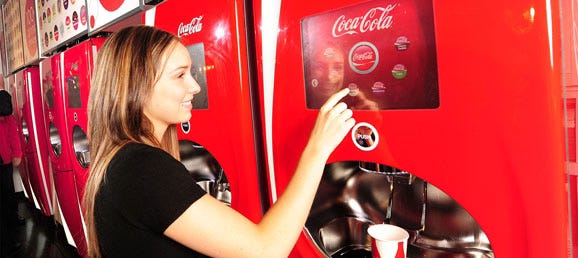
Each purchase becomes a data point — what flavor, what time, what location, what combination — aggregated across millions of daily interactions into what amounts to a mother lode of customer information. “It’s actually the biggest live consumer taste test that’s going on anywhere on the globe,” Coca-Cola vice president Gigy Philip told the Atlanta Journal-Constitution. “There is no other company that has this.”
(6) Apple has reportedly reached a preliminary chip-making agreement with Intel. The details remain very thin — neither company has yet confirmed the deal and the Wall Street Journal didn’t specify which chips Intel will manufacture for which Apple devices. The U.S. government, which holds a 10% stake in Intel, apparently played an active role in brokering this relationship.
Apple designs its own chips, but relies heavily on TSMC to manufacture them — a concentration that occasionally creates supply constraints and leaves the company exposed to any eventual geopolitical disruptions in Taiwan. Adding a domestic fab, even as a partial alternative, reduces that vulnerability. For Intel, landing Apple as a foundry customer would be the credibility milestone it has long needed.
The deal, if confirmed, sits at the intersection of three converging interests: Apple wants supply chain resilience, Washington wants domestic chip production, and Intel simply needs the business.
(7) A year ago, investor and writer Vitaliy Katsenelson left the Berkshire annual meeting with an uneasy feeling — unsure about Greg Abel replacing Buffett — but this year he became a convert. Writing in Fortune, Katsenelson describes what changed his mind: Abel’s tour de force of operational knowledge and vision for improving a stable of subsidiaries that are not entirely living up to their potential.
“Choosing Greg was one of the most important decisions Buffett made in decades,” wrote Katsenelson. “At his first annual meeting, we could see why. A corporate Mr. Fix-It is walking through every business, identifying key performance indicators, installing the right incentives, bringing technology to them, and replacing managers who need replacing.”
(8) Dairy Queen’s total sales climbed about 3% last year to nearly $6.6 billion — buoyed by 10% same-store growth in China. CNBC’s Becky Quick asked CEO Troy Bader about how the rise of GLP-1 weight-loss drugs might affect the business going forward. “It’s hard for us to say right now,” he replied, “but definitely there is a trend right now that we need to be mindful of.” DQ will emphasize its a la carte menu and mix-and-match options for those customers looking to cut back on calories.
Bader also touched on DQ’s much-discussed decision to use an AI chatbot to take drive-thru orders. While he hopes the technology will eventually reach 99% accuracy, Bader is most excited for the human implications of handing rote work over to the machines. “If you didn’t have AI,” he said, “for the individual at the window, taking orders would be 100% of what they’re doing. [Now], I can be monitoring the quality of the product or providing hospitality to a guest in a different way. It’s about elevating the customer experience.”
(9) Fortune profiled American Express CEO Stephen Squeri and his impressive run atop the company. Since taking the helm in early 2018, AmEx has delivered 16.6% annualized total returns — outpacing competitors like JPMorgan Chase, Mastercard, Visa, and even the S&P 500 along the way.
Much of that success traces back to Squeri’s big, early bet on Millennials and Gen Z. Last year’s Platinum Card refresh — a simultaneous product upgrade and price hike — was perhaps the clearest demonstration yet of how much pricing power AmEx has built with its most aspirational customers.
A couple of fun Berkshire-related details:
Lunch with Warren Buffett is exactly what you’d expect. “He orders in Big Macs and fries,” said Squeri, “and I insist he chuck the china plates and that we eat everything [right] out of the box.”
When it mattered most, Squeri called Buffett. At the height of the pandemic, Squeri decided against layoffs and chose instead to invest in new cardholder benefits better suited to a quarantined world — an unconventional path that risked significant short-term losses. But, before committing, he rang his biggest shareholder for a gut check. After confirming AmEx had enough capital to weather the storm, Buffett gave his blessing: “What’s important is that during these times, you take care of your customers and you take care of your brand. If you lose customers and the aura of your brand, it’s hard to get them back.”
(10) In the coming months, McLane will deploy Aurora Innovation’s self-driving trucking technology along routes in Texas and the broader U.S. Sun Belt. The Berkshire-owned grocery and foodservice distributor has been running a supervised autonomous pilot program between Dallas and Houston since 2023. And, after accumulating 280,000 autonomous miles along this corridor, it’s ready to expand.
McLane settled on a thoughtful hybrid approach to the self-driving question. Aurora’s technology handles the long-haul “middle mile” between distribution centers — the long, highway-dominated stretches with predictable conditions. Human drivers take over for local delivery — with its increased operational complexity and occasional need for in-person relationship management. “Autonomous technology helps us drive greater efficiency across the supply chain,” said McLane Restaurant president Susan Adzick, “while our drivers remain focused on the critical last mile — and continuing to serve as the face of our company to customers.”
13f is out and Berkshire bought a ginormous amount of $googl…surprising since the equity had more than doubled from the April 25 low and with massive AI spending, free cash flow is a thing of the past. Buying Delta into an energy crisis is another head-scratcher