
I sometimes get asked to write more on investing basics as a helpful refresher.
As such, I’ve been on the lookout for anything that fit the bill — and finally found it in a Howard Marks speech from last year in which he walks a not-exactly-market-savvy audience through topics like the efficient market hypothesis, investor psychology, and market cycles. And does so in a way that resonates with novices and diehards alike.
Over the past few weeks, I have transcribed this speech for all paid supporters.
One of my favorite parts comes when Marks laments the rampant short-termism that infects so many investors today.
I started in Citibank in the investment research department and we used to think about investments as lasting six years. Now, very few last six months. Everybody is trading and everybody cares about what was your return last quarter [and] what are you going to make next quarter. And these things really don’t matter.
An excessive concern with the short term is really a way to go wrong — and ignoring the short term, in my opinion, is really a way to get an advantage over other investors. Everybody is looking at short-term performance.
By the way, if you go back fifty years, before computers were widespread, you would run a portfolio and the year would end and three, four, five days later you would find out what [your] rate of return was that year. They had to do a bunch of calculations by hand. Today, you can look at your Bloomberg machine on your desk in your office and you know your rate of return to this minute, in real time.
Given human nature, this encourages short-termism. If you know you are up 4.6% this month and everybody else is up 4.8%, you freak out and you engage in all this trading to try to get better [results].
There is a lot more where that came from — and it should land in your inbox early next week. So, if you’ve been on the fence about upgrading, now is the perfect time.
More news and notes from the Berkshire Hathaway orbit…
Berkshire Hathaway deepened its presence in Japan through a new strategic partnership with Tokio Marine Holdings. As part of the deal, Berkshire subsidiary National Indemnity Company will purchase an initial 2.49% stake in the Japanese insurance giant for approximately $1.8 billion (¥ 287.4 billion). These shares will come from Tokio Marine’s treasury stock “as it would be difficult for NICO to acquire TMHD shares in the open market”. But, to offset any dilution for existing Tokio Marine shareholders, the insurer plans to simultaneously repurchase an equivalent amount of its own shares using the proceeds from this sale.
Berkshire (via National Indemnity) will also assume a portion of Tokio Marine’s global portfolio through “whole account quota share” reinsurance. The two companies may explore potential M&A opportunities, as well, as part of this collaboration.
“This is not merely a business alliance,” Tokio Marine stated in a press release. “We believe that it establishes a long-term strategic relationship anchored by an equity stake that will serve as a powerful catalyst for the medium- to long-term growth of both companies.”
Ajit Jain echoed the sentiment: “We are pleased to build a long-term collaborative relationship with TMHD, which has a strong underwriting franchise and an exceptional management team. We expect this strategic partnership to create compelling long-term opportunities for both organizations.”
Berkshire may buy additional shares on the open market in the future, but pledged not to exceed 9.9% ownership without approval from Tokio Marine’s board. And, under a related agreement, for a period of time, it agreed not to sell any shares without written consent and will vote its shares in line with the recommendations of TMHD’s board.
On the same day as the Tokio Marine announcement, Berkshire director Chris Davis appeared at a Barron’s Live event and shared a few thoughts on the company. As a board member, he could not comment directly on Berkshire’s decision to invest in Tokio Marine, but described the insurer as a “dominant blue-chip organization”. Davis’s grandfather, the legendary Shelby Cullom Davis, built much of his fortune by identifying exceptional insurance outfits — and considered TMHD “the absolute crown jewel” of the Japanese insurance industry. “It is a wonderful company.”
Apple is off to a strong start in China this year. According to Counterpoint Research, iPhone sales surged 23% in the first nine weeks of 2026 — even as the overall Chinese smartphone market slumped 4% during the same period. The report also notes that Apple’s tight control over its supply chain gives it a clear advantage amid the current global memory chip shortage. While many Android OEMs have had to raise prices to offset higher component costs, Apple can absorb a little margin pressure to hopefully further gain market share in China and around the world.
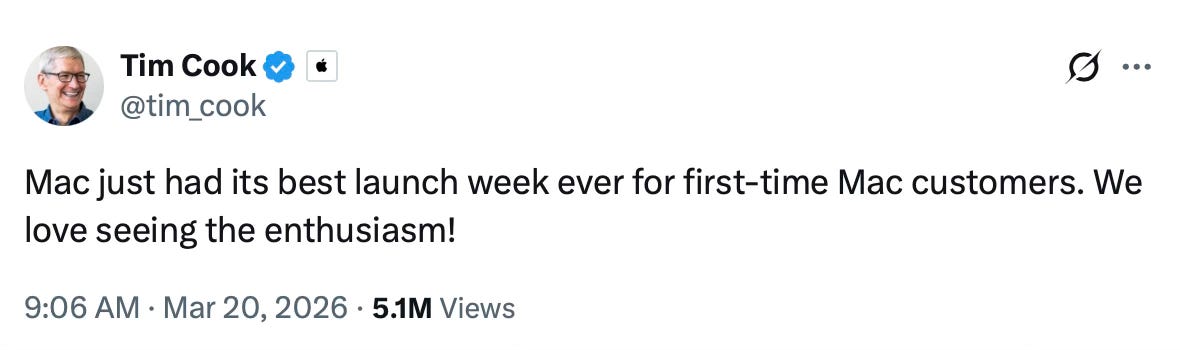
Back home, the news is similarly positive. The affordable MacBook Neo — priced at just $599 (and $499 for students and educators) — appears to be a hit right out of the gate. Apple CEO Tim Cook wrote on X: “Mac just had its best launch week ever for first-time Mac customers.” The strong demand is already showing in shipping delays for the new laptop. It’s still early days, but the Neo seems to be doing exactly what it’s supposed to — bringing new customers into the Mac ecosystem who might have been priced out of other models like the MacBook Pro or MacBook Air.
In other Apple news, Bloomberg recently profiled senior vice president John Ternus, who is widely viewed as Cook’s likely successor. The piece includes candid comments from current and former Apple employees — both on and off the record — painting a picture of a capable, low-key leader who would deliver continuity rather than dramatic change. Former procurement chief Tony Blevins described Ternus as an “outstanding and obvious choice” as the next Apple CEO.
Yet anyone expecting a sharp break from the Cook era might be disappointed. One person close to Ternus told Bloomberg: “If you think Tim Cook is doing a good job, then you’ll think John Ternus is going to do a good job.” Speaking of Cook, the article notes that he “seems content to leave everyone guessing” about his future — but also adds that many insiders do not think any big changes are imminent.
BNSF Railway CEO Katie Farmer took aim at the Union Pacific x Norfolk Southern merger during a National Grain & Feed Association fireside chat. She challenged the official expectation that the combined railroad would actually deliver its projected 12% volume growth over the next three years — especially since UP’s volume dropped after its last merger. If that happens again, the resulting cost pressures would likely be passed on to customers.
Farmer acknowledged that mergers are a fact of life on the rails, but questioned whether this is really the right time for such a big one. “Our railroad is a compilation of a bunch of different railroads,” she said. “But in the past, there were driving reasons for railroad mergers. Either they were financially challenged railroads that needed to have a merger or we had customers that could see the benefit of the merger. We were in an industry where we had hundreds of railroads. That’s not where we are today. We have six Class I railroads … The times [just] aren’t the same.”
Reuters reports that Occidental Petroleum CEO Vicki Hollub is expected to retire later this year. And, according to three people familiar with the matter, COO Richard Jackson will likely succeed her. The report notes, though, that the ongoing conflict in the Middle East might yet alter her plans. “We have a strong board with strong governance,” replied an Oxy spokesperson, “and we do not comment on speculation.”
Brooks Running will open its first true standalone retail store in Seattle’s University Village later this summer. “[Seattle] is the place that gave birth to the modern version of Brooks,” senior vice president Mike Billish told the Seattle Times. “In the same way that Starbucks and Microsoft and Amazon are known around the world as Seattle brands, there isn’t a single reason why we don’t want the same thing.” Located near the popular Burke-Gilman Trail, “the demographic [at University Village] perfectly overlaps with the core of our customer base.”
And, in closing, Berkshire collected a couple of big dividends this week: $144.8 million from Bank of America and $130.3 million from Kraft Heinz.
Interesting comment about Vicki Hollub possible retirement.
I think the market has been slow to recognize the value in Berkshire’s investments in Oil and Gas through Occidental and other positions, which are proving to be very valuable in the current environment and will probably continue to be so.
With Class A shares dropping, like the rest of the market, I bet Greg is looking at making a few purchases, both for his account and Berkshire's.