
The wait is over: New CEO Greg Abel’s first letter to shareholders — alongside Berkshire Hathaway’s annual report — will drop online tomorrow morning. Which makes today, for all practical purposes, like Christmas Eve around these parts.
For many years now, on the last Saturday of February, I would pop out of bed bright and early — ready to devour Warren Buffett’s latest letter just as soon as it appeared on Berkshire’s website. And I don’t expect that to change in the Abel era.
In the meantime, if you need something to while away the hours, Christopher Bloomstran released his own annual letter to Semper Augustus clients on Wednesday. This year’s effort clocked in at an astounding 184 pages — with around half of that his admirably extensive analysis of Berkshire’s business empire.
It will take me a while to work through the whole thing, but I did flip ahead to see Bloomstran’s new intrinsic value estimate for the conglomerate.
“Far more important than short-term swings in stock prices is growth in intrinsic value per share and how Berkshire invests its capital,” he wrote. “By Semper’s math, 2025 intrinsic value grew 9.3% from $1.126 trillion to $1.23 trillion, or in per-share terms to $855,396 per A share and $570 per B share.”
Berkshire shares currently trade in the $745,000 (A) and $490 (B) range.
Other news and notes from the Berkshire Hathaway orbit…
Berkshire Hathaway director Chris Davis appeared on Bloomberg ETF IQ this week and, among other things, discussed the conglomerate’s post-Buffett future. And, to illustrate his confidence, he turned to his favorite historical parallel — Standard Oil’s remarkable endurance long after John D. Rockefeller stepped away. “I would challenge you to name the second CEO of Standard Oil,” he said. “And Standard Oil was the most valuable company in the world for something like twelve decades.”
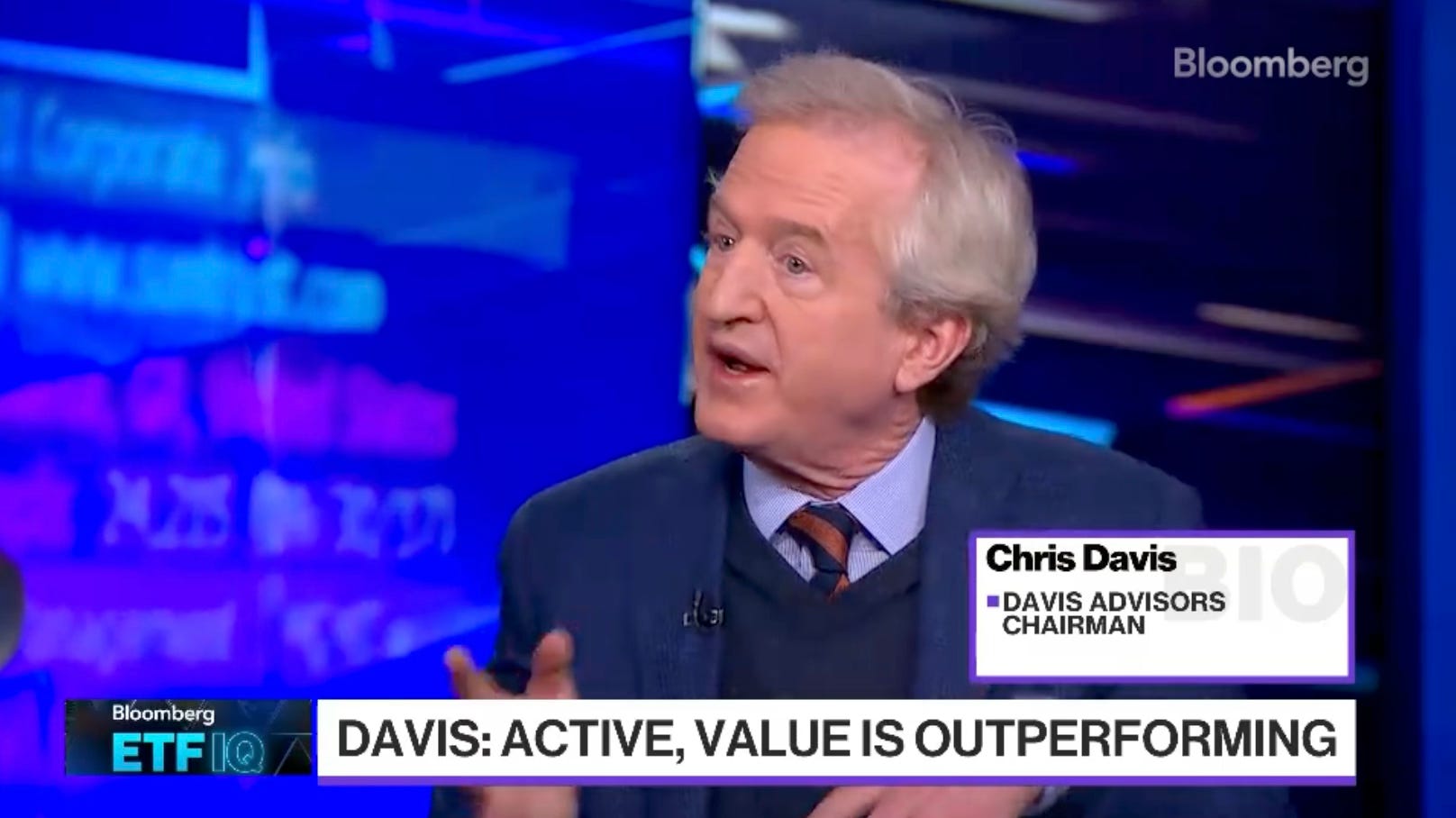
The real key to longevity, Davis argued, is not celebrity leadership — but durable foundations. “With Standard Oil and these other businesses [like Apple and Amazon], you had long-lived assets and you had very strong cultures. You don’t need to be able to name the second CEO to have this operating mindset and the ability to execute and protect that culture. Berkshire has very long-lived assets and a spectacular culture.”
Davis also praised one of Berkshire’s smaller holdings, Capital One Financial, as “the greatest fintech company in the U.S. for the last 25-30 years”. (Berkshire owns 1.1% of Capital One, a position currently valued at $1.5 billion.) “Did you know Capital One is in the top ten of all companies for AI patents?” he asked. “Isn’t that amazing? Here’s a company trading at 12-13x earnings with a 30-year record, run by the founder, [and] the key is the culture, the tech stack, and the scale to make the investments. I put Capital One right at the top of that list [of great fintech stocks].”
A federal appeals court unanimously reversed an $8 million verdict against BNSF Railway for two asbestos-related deaths in Montana. BNSF had transported asbestos-laden vermiculite from a W.R. Grace mine in Libby, Montana, for decades as required under federal “common carrier” laws. These obligations compel railroads to carry goods regardless of content — and provide broad liability protections for doing so. This win should also bolster BNSF’s defense in hundreds of other asbestos-related lawsuits currently pending in Montana courts.
In the continuing saga of PacifiCorp, the beleaguered BHE subsidiary agreed to pay $575 million to settle all known federal government claims related to six wildfires in Oregon and California. This payment will reimburse the U.S. Forest Service and Bureau of Land Management for firefighting costs and support restoration efforts on nearly 290,000 acres of burned public land. Notably, PacifiCorp did not admit liability for any of the fires as part of this settlement.
“This settlement is another significant milestone demonstrating our ongoing commitment to resolve all reasonable claims related to the devastating fires that affected Oregon and California,” the Berkshire-owned utility said in a statement. “Setting aside claims arising from the Beachie Creek / Santiam Canyon fire, we have now settled nearly 90% of known claims for a total of more than $2.2 billion.”
Kraft Heinz CEO Steve Cahillane discussed his decision to pause the company’s planned separation on CNBC last week. He was initially enthusiastic about the split, but changed his mind after taking a closer look under the hood. “One thing that [worried me] is the exit rate of the business, particularly what we call the North American Grocery Co., was not as strong as we would have liked it to be,” he said. “And to do a successful separation, you really have to have a business in a healthier state.” Cahillane realized that resources would be better spent shoring up the scuffling North American business — and a separation could always be revisited in the future.
“I’m in favor of preserving the optionality [to separate or not] going forward,” he said. “Once we get this business humming and moving in the right direction and growing, we will have all sorts of opportunities. One of which will continue to be separation … but there are other value creation opportunities in front of us as well.”
In Cahillane’s opinion, the 3G Capital cost-cutting campaign did a real number on Kraft Heinz as a whole. “Since the merger ten years ago, we have lost share each and every year. We were very lean — the 3G model of really taking costs out affected the company greatly. We took way too much out of marketing and way too much out of our SG&A. We were operating at levels that were half the overhead of some of our peers and very low marketing levels. We are now, with this $600 million investment, getting closer to our benchmarks for those same things. It won’t happen overnight. It will take some time. But the company, for ten years, has lost share every single year — and the last year was one of the worst. So we have to fix that.”
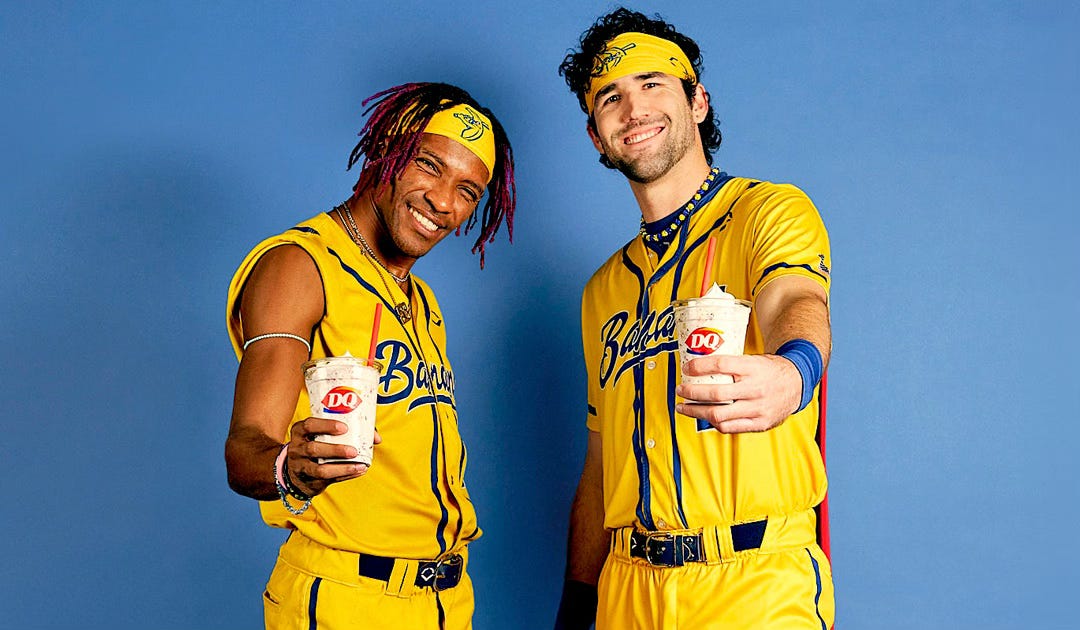
Dairy Queen announced a new partnership with the wildly-popular Savannah Bananas baseball team for the upcoming season. DQ will launch a new Savannah Bananas Split Shake to commemorate the occasion — and will run the “DQ Shake Snag” promotion at Bananas games this summer, giving any fans who catch a foul ball there the chance to win free shakes.
“Our partnership with the Savannah Bananas is a natural fit for DQ,” said executive vice president Maria Hokanson. “We’re two brands that put the fan experience first, bring people together to create special memories, and of course, love to flip.”
In a recent Risk & Insurance interview, Berkshire Hathaway Specialty Insurance head of marine claims Chris Frick offered rare insights into Berkshire’s insurance operations. Contrary to widespread public perception that insurers hunt for excuses to deny claims, he noted that BHSI takes the opposite approach. “My adjusters have always been trained to find coverage first,” said Frick. “Most of the public thinks the big bad claims people are trained to find reasons to deny claims. [But] most of the people in claims roles that I know, their job is to affirmatively find coverage.”
Frick also shared a hiring principle that echoes Charlie Munger’s emphasis on intellectual humility and mental flexibility. “I ask a lot of questions when I interview candidates about what makes them change their mind, how they come to the process of changing their mind, and how difficult that is for them.”
“You don’t want somebody that’s going to cave every time they see something and say, ‘Oh, yeah, I agree with your position.’ You want them to be firm in their position, but [also] open to the idea that they might be wrong.”
And, finally, a few odds and ends to finish the week…
In the private jet game, there is NetJets — and then there is everyone else. According to the latest ARGUS TRAQPak data, NetJets logged 719,086 flight hours in 2025, an 8.1% increase year over year, which solidified its commanding 13.27% share of the total tracked market. Runner-up Flexjet lags back at 5.25%.
This week, Berkshire collected $33.7 million in quarterly dividends from Sirius XM and (somewhat less impressively) $173,423 from Jefferies Financial Group.
I will have more on Berkshire’s recent New York Times investment in the coming weeks. But, in the meantime, check out WorldlyInvest for a closer look at what might have drawn Berkshire’s eye to the media giant.
Word out of India is that Berkshire vice chairman Ajit Jain recently purchased a luxury apartment in Gurugram for ~$9 million.
Hopefully Ajit’s purchase isn’t a sign of near term retirement!
Your Christmas Eve analogy is very true for me. I’ll be refreshing my browser tomorrow morning starting at 7:55 or so until the report appears!
Nice insight