
The annotated transcript for February will go out to paid subscribers early next week (probably on Tuesday morning). This one is a little different — a reflective interview with Peter Lynch, filmed last year, in which the legendary Fidelity Magellan manager revisits the core principles and ideas that put him on investing’s Mount Rushmore.
Lynch has kept a relatively low profile since stepping back from Magellan in 1990, so it’s nice to hear what he thinks has — and has not — changed about the money game. Plus, he remains one of the very few investing minds that can rival Warren Buffett for his ability to distill big ideas into snappy one-liners that stick with you for years.
One of my favorite parts from the interview comes when Lynch recounts the time he unintentionally ended up advising singer/actor Barbra Streisand on her stock picks.
I did an ad for Fidelity with Lily Tomlin. She’s very close with Barbra Streisand. So I’m on vacation with my wife and two other couples and my secretary says, “Barbra Streisand has called three times. She really would like to talk to you.”
I said, “Sure, I’ve got some time this afternoon.”
So I call her and she says, “I own all these stocks and I’m getting up at 5 a.m. looking [and worried about] this stuff.” She said, “I never did drugs. I never did marijuana. I just can’t sleep. What do I do?”
I said, “Tell me five things you own.”
She named five companies and I said, “Okay, what do they do?”
She didn’t have any idea. This is an incredibly talented person and she had no idea what those companies did. What are you going to do if they go down 50%? If you don’t understand what you own, you’re toast.
That single exchange captures Lynch’s entire philosophy in a nutshell: Invest in what you understand. Without that foundation, volatility becomes unbearable.
So, if you’ve been on the fence about upgrading, now just might be the perfect time.
Other news and notes from the Berkshire Hathaway orbit…
Berkshire Hathaway released its final 13F of the Warren Buffett era on Tuesday, providing a snapshot of the conglomerate’s stock portfolio as of December 31, 2025. There were no blockbuster buys or sells to mark the end of an epoch. No dramatic “one last swing” from the Oracle himself. Berkshire did open a small-ish position in the New York Times — dipping back into the newspaper/media world after selling its stable of publications in 2020 — but its size means this probably wasn’t Buffett.
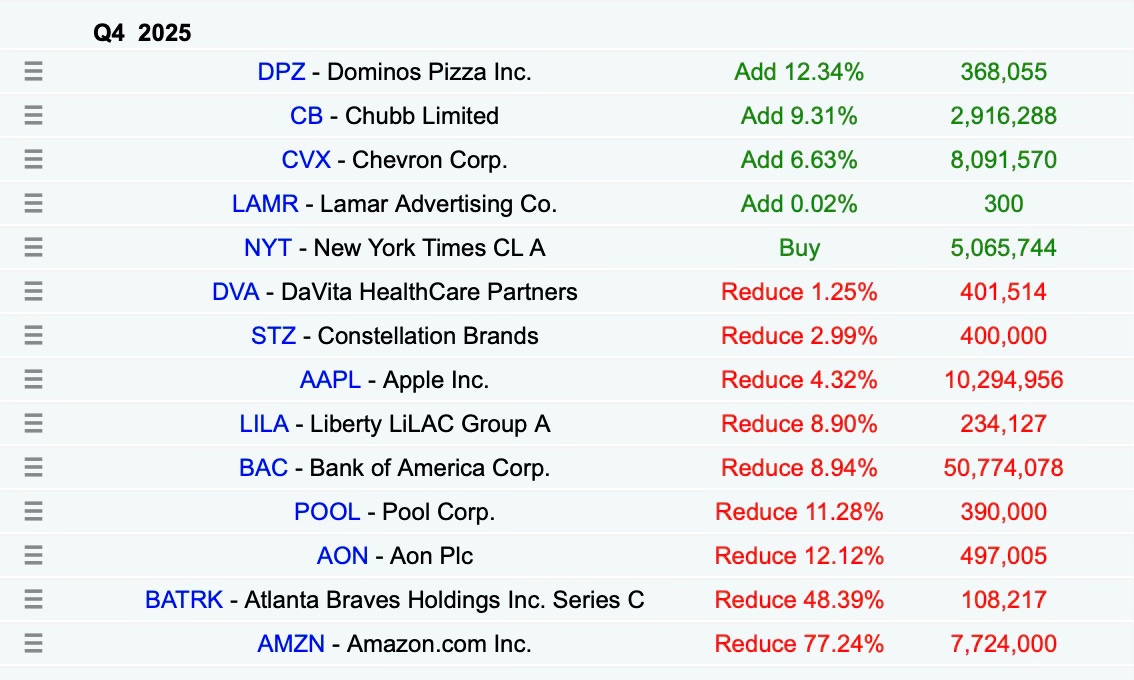
Among the top five holdings, Berkshire continued to trim Apple and Bank of America — while adding 8.1 million more shares of Chevron. And, after six straight quarters of purchases, it also now owns 9.9% of Domino’s Pizza.
On the sell side, Berkshire slashed its stake in the Atlanta Braves by nearly half and in Amazon by even more. For everything else, the chart above shows all of the portfolio’s ins and outs during Q4 2025. (Later on Tuesday, we also got another filing that revealed Berkshire sold ~330,000 shares of Liberty Live Series C stock in January.)
PacifiCorp agreed to sell its wind and natural gas generation/distribution assets in Washington state to Portland General Electric for $1.9 billion. “This will improve the company’s financial stability,” said CEO Darin Carroll, “while simplifying our operations to support our long-term commitment to customers in each of our remaining states.” The press release also noted that “diverging policies among the six states PacifiCorp serves have created extraordinary pressure” on the utility.
That’s in reference, of course, to the wildfire litigation that has plagued PacifiCorp over the past few years. The company has even warned about a possible liquidity crisis if its credit ratings slip below investment grade. As such, this asset sale seems a clear step towards shoring up the balance sheet while also streamlining operations.
Both Greg Abel and Warren Buffett made it clear at recent annual meetings that they would not let regulatory, political, or social pressures erode value at BHE indefinitely. And the rubber seems to have finally met the road in that regard.
BNSF Railway had a banner year on the service front — with high marks in the all-important efficiency metrics of dwell and velocity. Dwell tracks the average time a railcar sits idle in a terminal before moving on to its next stop. Basically, lower dwell means less congestion and faster turnarounds. (Like in golf, lower numbers are better.) In 2025, BNSF slashed dwell on its merchandise train network by 13% to historic lows. In fact, every single month set a new record. On average, railcars spent three fewer hours sitting in terminals compared to the previous year.
Velocity measures how many miles a railcar or locomotive travels per day. (So, in this case, higher is better.) Across the BNSF network, velocity jumped ~10% last year and “trains holding” was cut in half. Such efficiency improvements can even unlock more capacity — with BNSF delivering over 60,000 additional days of service in 2025.
RC Willey president Jeffrey Child will retire on April 27, but plans to remain on the furniture retailer’s board of directors. “After almost 50 years with RC Willey,” he said, “I have great gratitude for the opportunities, challenges, and friendships that have shaped my career. It has been a pleasure to work alongside our dedicated and talented associates. The company is in a wonderful position, and by continuing on the board of directors, I hope to play a role in the continuing success of RC Willey.”
Child leaves as a furniture legend — named one of Furniture Today’s Titans of the Industry in 2024 and inducted into the American Home Furnishings Hall of Fame last year. Lynn Lloyd, currently vice president of merchandising, will replace Child — with CEO Scott Hymas calling this “a thoughtful and planned leadership transition”.
Jeremy Padawer, soon-to-be president of Jazwares, talked toy biz with Toybook. “We have always been early,” he said. “If the toy industry were a cake, it would be two parts evergreen and one part trend. We specialize in independently-owned IP distributed on new frontiers. You must act quickly — not just to sign, but also to manufacture. That’s the nature of trend. If you aren’t first to the table — and you aren’t fast to tool, manufacture, and distribute — then you’re baking with only one of the two key ingredients for success in the toy industry.”
“The biggest challenge retail faces daily is balancing safe bets with new opportunities,” continued Padawer. “Without a Toys ‘R Us with 1,000 stores singularly focused on toys, we tend to bend toward so much safety at mass. Innovation always drove excitement. We are starved for it.”
Henrique Braun, who will become CEO of Coca-Cola at quarter’s end, laid out a mission statement of sorts on the company’s recent earnings call. “While we are proud of what we have accomplished,” he said, “future success is never guaranteed. We must remain discontented. Every day, our system needs to focus on being a little bit better and sharper everywhere to drive transformational impact.”
“We have enduring strength, which includes an incredible foundation of 32 billion-dollar brands and unmatched system reach. Our mission is both to increase this number of billion-dollar brands and to turn today’s billion-dollar brands into tomorrow’s multi-billion-dollar brands.”
And, in closing, Berkshire collected a couple of smaller dividends this week: $8.7 million from Ally Financial and $3.6 million from Lennar.
Hopefully the Pacificorp divestment signals to regulators that Berkshire is serious about exiting markets where the regulatory/legal situation makes no sense. No other company is more likely to put in the investments needed to improve the grid, harden it against future wildfires, etc…
I cant wait to hear Kingswell on NY Times! I’m going to be resubscribing just for that.