
Berkshire Hathaway is not expected to release its annual report until later this month, but subsidiary Brooks Sports provided a few early crumbs for us to chew over.
The running company increased revenue by 16% last year, marking nine consecutive years of sales growth. “Our consumer is very, very healthy right now,” CEO Dan Sheridan told Bloomberg Businessweek Daily. “More people around the world are running and walking — and Brooks is winning the runner at the cash register.”
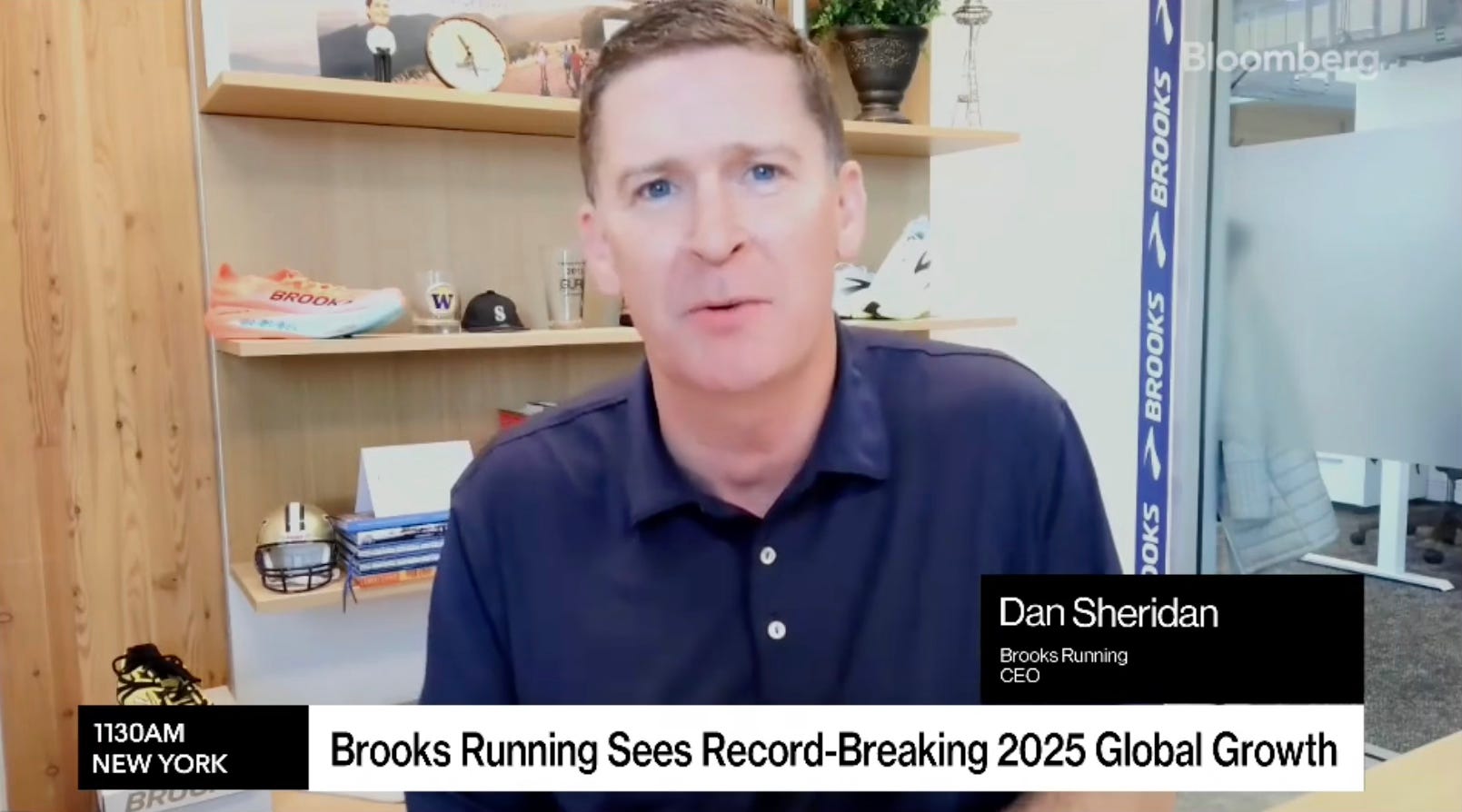
Sheridan explained that running holds such a high priority for customers that they typically prioritize shoes and apparel over other discretionary purchases when and if budgets tighten. Add in a stabilized supply chain and broad-based growth across all geographic regions — and there is much to be happy about over in Brooks land.
The U.S. remains Brooks’s largest market, accounting for roughly 80% of its revenue, though the company is in the midst of aggressive expansion in Western Europe and Asia. “We’re just getting started in China,” said Sheridan, where revenue shot up 245% in 2025. “When we look at the total addressable [global] market, it’s a $48 billion market in terms of run.”
Sheridan also touched on a few other topics of interest during the Bloomberg interview.
On being owned by Berkshire:
I hope we stay forever with Berkshire — and I believe we will. We are so fortunate to be owned by Berkshire. And, more importantly, I as a CEO have a very long time horizon that I focus on because of our ownership. That’s a benefit to us in every decision we make.
Ownership matters in business and we’re lucky and fortunate to have the ownership of Berkshire Hathaway. We continue to take a long-term approach to this strategy. When we enter markets like China, like in Europe, the exposure we have there and the growth we have there, the fact that we can focus on 10-20 year horizons here is very different than our competition. I don’t take that for granted.
On working with new Berkshire CEO Greg Abel:
The word that comes to mind is consistent. It’s consistent with the culture of deserved trust and empowerment. Greg has always led with that. It’s consistent in terms of how they think of the subsidiaries.
Greg is a very consistent manager — and will remain that for us. I believe that. I had a unique opportunity in December to travel to Omaha and spend some time with both Greg and Warren — and, now, Adam Johnson, who is leading our division. I can tell you that the same things are true throughout the leadership at Berkshire. What an advantage for Brooks!
On what sets Brooks apart from the competition:
We are a product company, first and foremost. We spend hours, months, years researching the biomechanics of human motion. We are in the business of keeping people healthy — running farther, faster, longer. We are in our 25th year of 14% compounded annual growth because of the position we have in product. We win, first and foremost, in product.
The second thing is we execute really well as a business. We sell in over 55 countries around the world. We have developed a supply chain and an operation of excellence that we think wins in every market. That’s not easy to do.
“This brand speaks to runners,” finished Sheridan. “We are an authentic, relevant brand that understands the journey of runners around the world.”
Other news and notes from the Berkshire Hathaway orbit…
In an abrupt strategic shift, Kraft Heinz pressed pause on its planned separation. New CEO Steve Cahillane said that the company’s problems are “fixable and within our control” — and announced an additional investment of $600 million to help turn around its beleaguered domestic business. This surprising pivot came as welcome news to Berkshire Hathaway, which had opposed the break-up from the get-go and seemed ready to drastically reduce its 28% ownership position in Kraft Heinz.
“We support CEO Steve Cahillane and the Kraft Heinz Board of Directors’ decision, under Steve’s new leadership, to pause work on the company’s previously planned separation,” Greg Abel said in a statement. “As a result, management can commit to strengthening Kraft Heinz’s ability to compete and serve customers.”
One of Warren Buffett’s closest friends from his early investing days, Marshall Weinberg, passed away a few months ago. Buffett sent his condolences in a letter that was read aloud at a recent memorial service. “I met Marshall 74 years ago when we were both attending Ben Graham’s class at Columbia,” he wrote. “It was a small group, only about 15-20 students. It was the most remarkable learning experience that I have ever had. Ben was a great teacher, combining wisdom, imaginative illustrations, and humor in his weekly appearances on Thursday afternoons during the spring semester. Out of those sessions, I made at least five lifelong friends, Marshall among them. Subsequently, he became a charter member of what I call the ‘Graham Group’.”
“Among our members, Marshall became universally liked and admired. He was a friend to all and a confidant to many. Marshall was generous in every way, both monetarily and on a deeper one-on-one human basis. He never lost a friend.”
Berkshire’s investment in Japanese trading houses surged to new highs after the country’s snap election over the weekend. The combined market value of the conglomerate’s positions in Itochu, Marubeni, Mitsubishi, Mitsui, and Sumitomo now totals more than $45 billion — already a three-bagger(ish) in Peter Lynch parlance.
According to Counterpoint Research, the iPhone accounts for nearly 25% of all active smartphones. That makes Apple the global leader in this category, well ahead of Samsung in second place. “This is driven by strong user loyalty, a deep iOS ecosystem, and tightly integrated services,” said an analyst. “In 2025, Apple added more net new smartphone devices than the next seven leading OEMs combined.”
In other Apple news, Bloomberg shared details from an all-hands staff meeting in which CEO Tim Cook discussed the company’s recent executive turnover — and his own eventual retirement. “I spend a lot of time thinking about who’s in the room five years from now, ten years from now,” he said. “I am obsessed with this.”
He added that most of the departures were carefully orchestrated and “not surprises” to him. “This is an important part of leadership, thinking about these things and having plans in place. You know, when people get to a certain age, some are going to retire. This is kind of a natural thing.”
Sirius XM lost more subscribers in 2025, but remains focused on free cash flow. The satellite radio provider lost more than 300,000 paid subscribers and expects that number to come in “modestly lower” this year, too. But, that being said, CEO Jennifer Witz pointed to the $1.26 billion of free cash flow (up 24%) as a reason for optimism.
“We understand the importance of subscribers,” she said on the company’s earnings call. “We’re very focused on improving the trends … but I would say that even if we don’t, we have incredibly strong and growing free cash flow generation for years to come. We’re being very disciplined about the interaction between subs and FCF.”
And, finally, a few odds and ends to finish the week…
When a new post from The Brooklyn Investor hits the streets, I drop everything and read it right away. Check out the latest one for some interesting thoughts on the Buffett-to-Abel CEO transition and Berkshire’s future.
BNSF Railway announced that it had another perfect parcel delivery record during the holiday season. All in all, the Berkshire-owned railroad delivered more than 80 million parcels on time, a 9% increase over last year.
Berkshire collected more than $210 million in quarterly dividends this week — $124.3 million from American Express, $61.9 million from Apple, $13.7 million from Constellation Brands, $3.6 million from Nucor, $3.5 million from Mastercard, and $3.1 million from Aon.
Alphabet raised some eyebrows with its plan to spend $175-185 billion for capital expenditures over the coming year. The AI arms race ain’t cheap.
Per usual, lots of good stuff here Kevin. Thanks, as always.
Three quick takeaways:
The Brooks Moat: 245% growth in China is staggering, but their real edge is "permanent capital." It allows for biomechanical perfection over fast fashion cycles.
The Japan Masterclass: Turning a $14B cost basis into $45B+ is a clinic in the "carry trade." Getting paid a dividend spread while the assets triple is pure Buffett math.
The Cash Machine: Sirius XM losing subs while growing FCF to $1.26B is a classic "cigar butt" play. It’s not always about the user count; it’s about the efficiency of the engine.
Poignant to see the tribute to Marshall Weinberg. It’s incredible that the lessons from a Columbia classroom 74 years ago still dictate global strategy in 2026.
Check out The IGP Paradox #2 on more thoughts about Berkshire Hathaway