
In just a few short hours, we will learn all the ins and outs of Berkshire Hathaway’s second quarter investment activity. The 13F should land online a few minutes after four o’clock this afternoon. And, making it all that much more exciting, this isn’t any old filing. For the first time in three-and-a-half years, Berkshire bought more stock ($23.5 billion) than it sold ($3.7 billion) — and most of those moves remain a mystery.
Set aside the $10 billion private placement with Alphabet — revealed to the public back in June — and we still have $13+ billion in purchases unaccounted for.
Reading financial filings might not be everyone’s idea of a fun Friday night, but these are the sacrifices I’m willing to make for this newsletter. 😜
In other above-the-fold Berkshire news, CEO Greg Abel will travel to Japan next month to meet face-to-face with his counterparts at Mitsubishi, Mitsui, Marubeni, Itochu, and Sumitomo. (Berkshire owns ~10% of each of these trading houses.)
More news and notes from the Berkshire Hathaway orbit…
AM Best boosted the outlook for Berkshire Hathaway’s GUARD Insurance Companies from negative to stable. A well-deserved vote of confidence in the unit’s “operational turnaround” under a new management team, crediting the corrective measures put in place since its underwriting problems first surfaced a few years ago. GUARD’s underwriting results had sharply deteriorated in 2023-24 due to mispriced risk across many of its lines, forcing Berkshire to step in and set things right.
GUARD exited its homeowners operations entirely and tightened underwriting guidelines in all areas of the business. Those changes — plus a significant capital infusion from National Indemnity — convinced AM Best that the worst is over.
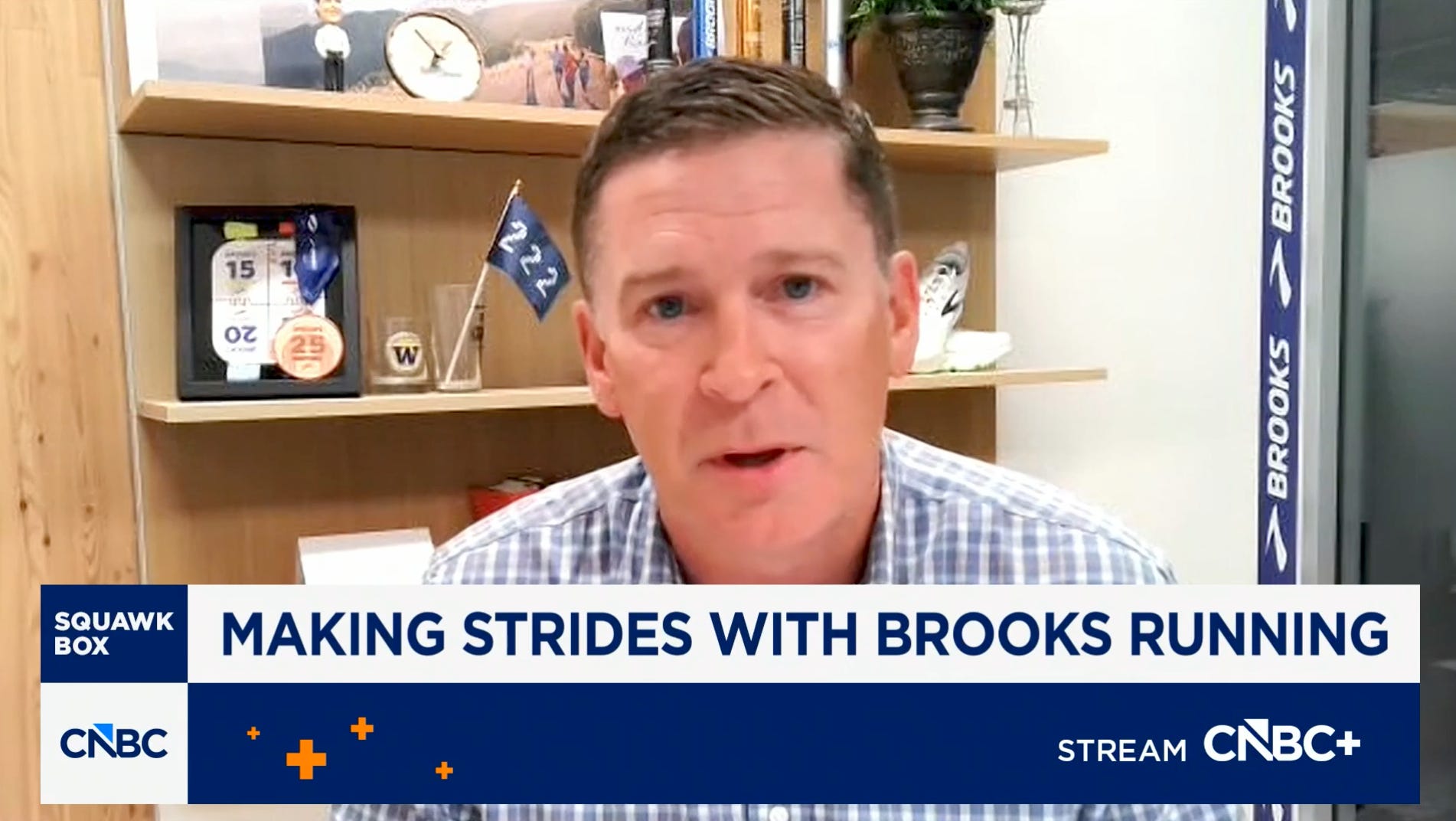
Berkshire’s 10-Q told us that Brooks Running’s revenue and earnings increased in the second quarter — but, happily, the footwear company itself filled in the details. Brooks posted 14% revenue growth in the first half of the year — with strength across every region. Sales climbed 9% in the Americas, 39% in EMEA (Europe, Middle East, and Africa), and 10% in the Asia-Pacific. CEO Dan Sheridan called it a “broad growth story” for the company, as runners continue to pay up for premium shoes and apparel.
Brooks also retained its position as the #1 brand in U.S. specialty retail footwear for the sixth straight month. Long may that continue.
Occidental Petroleum CFO Sunil Mathew laid out the company’s capital game-plan for the rest of the decade: pay down debt and then pay back Berkshire. “Our immediate cash flow priority remains to reduce principal debt to $10 billion,” he said on last week’s earnings call. “After we achieve the $10 billion principal debt milestone, our focus will be to further reduce net debt. We will balance additional debt reduction with building cash ahead of the preferred equity redemption in August 2029.”
“Share repurchases will remain opportunistic,” added Mathew. “Any continuous share buyback program will be a lower priority until the redemption of the preferred.”
Occidental can begin voluntarily redeeming the remaining $8.5 billion of preferreds in August 2029, which will move Greg Abel and company one step closer to decision day. Berkshire still holds warrants for 83.9 million shares of OXY 0.00%↑ at $59.59 a piece that are exercisable until one year after the preferreds are fully redeemed.
Apple still owns the premium smartphone game — even if its crown sits a little looser these days. New data from Counterpoint Research shows that the tech giant controlled 65% of the global premium smartphone market (devices priced $600 and up) through the first half of this year — up from 63% a year ago. The iPhone 17 lineup, particularly the base model, powered a 9% jump in Apple’s premium revenue.
This segment, though, has grown more competitive in recent years. Apple’s premium share is still well below the 74% it commanded in 2022, as it faces renewed pressure in China from local rivals like Huawei, Xiaomi, and others.
Coca-Cola just broke ground on a $650 million expansion of a Fairlife plant in Michigan, doubling down on a brand that already pulls in about $4 billion a year. “The [245,000-square-foot buildout] will allow us to bring in an additional four million pounds of milk from Michigan dairy suppliers each day,” said CEO Becca Kerr, “and significantly increase capacity and availability of Fairlife products.” It’s also nearing completion of a separate production facility in upstate New York.
And, c’mon, Fairlife needed a little good news.
This milestone comes just a few weeks after a ransomware attack knocked out the company’s entire U.S. production capacity for ten-plus days in mid-July. Coke later noted that its subsidiary’s misfortune “has not had, and is not reasonably likely to have, a material impact on the company’s financial condition or results of operations”.
In honor of America’s 250th birthday, Bank of America will put big money behind our nation’s next chapter. This week, the bank unveiled a $250 billion Critical Infrastructure Finance Initiative — and aims to mobilize and deploy the full amount by (appropriately enough) July 4, 2027. Financial activity (including lending, investing, capital markets, etc.) should move fast across three fronts shaping the modern American economy: digital infrastructure for data centers and semiconductors, energy systems spanning renewables to grid storage, and core infrastructure covering transportation, water, and critical minerals.
“This initiative reflects our confidence in the country’s future and the investments that will shape it,” said co-president Jim DeMare. “The infrastructure that powers our economy, strengthens our energy security, and secures our technological leadership will drive growth, create jobs, and define America’s next chapter.”
BNSF Railway rolled out expanded intermodal service between two of the Southwest’s fastest-growing freight markets. It not only trims the trip between Phoenix and Dallas-Fort Worth to just over three days from train departure to cargo availability, but also runs six days a week to match surging demand in both metros. Shippers bracing for peak season — and already squeezed by trucking costs — now have an attractive alternative that doesn’t sacrifice speed or reliability.
Last week, I kicked off the newsletter with Ribbit Capital founder Micky Malka’s story about meeting Charlie Munger, including the Berkshire vice-chairman’s advice on the “power of time”. Turns out I wasn’t the only one thinking along those same lines of compounding, time, and patience — as Mark Tobak tackled several similar ideas over at Hedge Fund Alpha. Give it a read.
Shortly before this issue went to press, Berkshire dropped two new filings:
CFO Charles “Chuck” Chang purchased two Class A shares ($1.5 million total) through a limited liability corporation controlled by him and his spouse.
General counsel Michael O’Sullivan added 488 Class B shares ($250,000) to his living trust. He bought a similar amount of Berkshire stock back in May after the Q1 report, so perhaps this will be a regular post-earnings occurrence.
Check back on Monday for a full review of Berkshire’s Q2 investment activity!
Great to see the new CFO with 8 A shares. This is a larger holding than certain Berkshire directors who really should own more shares.