
(1) The Wall Street Journal took a closer look at Greg Abel’s first 100 days as Berkshire Hathaway CEO — and how some of his changes are more sweeping than originally anticipated. Like the striking revelation (according to “people familiar with Berkshire’s investments”) that Abel has already liquidated all stocks purchased and managed by Todd Combs, who will not be replaced after moving to JPMorgan Chase. That leaves Ted Weschler overseeing roughly six percent of the portfolio, with Abel and the still-involved Warren Buffett handling the rest.
Abel also spent much of the past year immersed in Berkshire’s insurance operations, logging significant time with vice chairman Ajit Jain. Who, I was happy to read, will be sticking around through this leadership transition — and beyond. Buffett put it simply: “[Jain] is probably going to be at the company for as long as he can.”
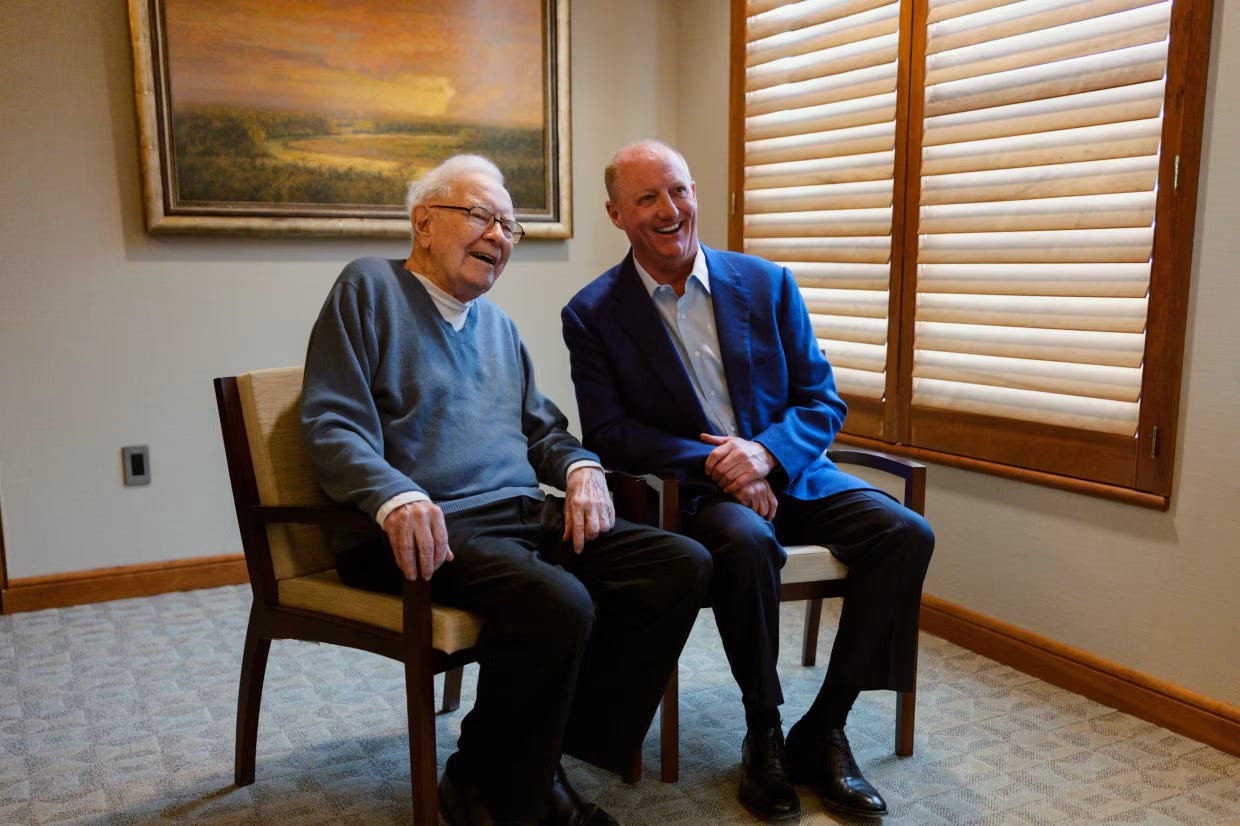
But perhaps the sharpest break from the Buffett era will be one of temperament. Whereas Buffett famously tolerated occasional underperformance — reluctant to confront managers he liked and admired — Abel shows much less sentimentality.
According to WSJ sources, that harder edge may even include selling struggling subsidiaries outright. Abel himself acknowledged that while some things will change, the bedrock of Berkshire is here to stay. “Warren, Charlie, and I — we have some differences, just in style and obviously in how we approach things,” he said, “[but] our foundational values continue to be what we build our company through.”
(2) In light of the shocking Combs news, Barron’s tried to piece together which stocks from the Berkshire portfolio might have ended up on the chopping block. We’ll get the official answer next month when Berkshire files its 13-F for Q1 2026, but some of the suspected names include Amazon, VeriSign, Capital One Financial, Visa, and Mastercard. Notably, Berkshire already sold close to 80% of its Amazon position late last year — which, in hindsight, may have been the opening act of a broader cull.
For fifteen years, guessing which manager was responsible for which investment has been something of a parlor game among Berkshire shareholders. Now, if this report is true, we might finally get some much-appreciated clarity.
Whatever remains in the portfolio becomes something of a Rosetta Stone. The holdings that survive are, by process of elimination, either Weschler buys or Buffett buys — and, based on size, we should have a pretty good idea which are which.
(3) Tim Cook will step down as Apple CEO on September 1 — handing the reins over to John Ternus, the company’s head of hardware engineering. Cook praised his successor as having “the mind of an engineer, the soul of an innovator, and the heart to lead with integrity and with honor”.
Ternus heralds a new direction for Apple after Cook’s operations-focused tenure. “Cook has never been a product person,” wrote John Gruber at Daring Fireball, “and to his credit, he never once pretended to be.” Cook understood exactly who he was, played ruthlessly to those strengths, and never wasted an ounce of energy pretending to be something he was not. In an era of CEOs cosplaying as visionary geniuses, that kind of honesty and humility is rarer than it looks.
Cook’s strengths served Apple extraordinarily well. The 2010s didn’t call for another Steve Jobs, but rather someone who could transform the iPhone from a breakthrough piece of technology into a global industrial phenomenon. Someone who could build supply chains of staggering complexity, manage a sprawling international operation, and guide Apple to become (on multiple occasions) the world’s most valuable company.
That was all Tim Cook.
But every era ends — and the demands on Apple have likewise shifted over time. “Today,” continued Gruber, “it feels like Apple needs a product guy at the helm again. John Ternus, more than anyone else at the company, seems like that person.”
(4) Warren Buffett, as expected, heaped praise on Cook after the announcement. “Apple would not be the Apple of today without Tim Cook,” he told Becky Quick. “What he has done with Apple could not be done by anybody I’ve known. Covering the world and getting along with countries with all kinds of histories and doing right by the customer, people who worked for him, certainly the shareholders — which we were lucky enough to be one of — he’s one of a kind.”
Cook, much like Buffett, will now become executive chairman of the company he long led. Both men, having built something extraordinary, are betting that the right successor — given the right support — can carry it forward. Cook, for his part, sounds excited about this next chapter. “My energy is high,” he told Apple employees earlier this week, “and I plan to be in this new role for a long time.”
(5) Ternus inherits a company in fine fettle. Let’s start with the number that matters most for any consumer franchise — customer loyalty. A new smartphone survey from SellCell found that 96.4% of iPhone users say their next phone will be another iPhone. That’s the highest figure ever recorded, up from 91.9% just five years ago. Android users, meanwhile, are nearly four times more likely to jump ship to another brand.
The stickiness runs deeper still. More than 83% of iPhone users have lived inside the Apple ecosystem for over five years, compared to just 34% of Android users who have stuck with the same brand that long. (That comparison comes with an asterisk, though, as Android spans many manufacturers while Apple stands alone as a single, unified choice.) Still, the directional story is hard to argue with. Once Apple has you as a customer, it tends to keep you as a customer.
iPhone shipments surged 20% in China during the first quarter, even as the broader smartphone market contracted 4%. That’s not only the fastest growth rate among any of the top six brands, but was also enough to push Apple’s market share up to 19% — just a single point behind hometown hero Huawei. The iPhone 17 lineup continues to punch well above expectations in a market that some had written off as structurally hostile to California-based Apple.
(6) AM Best reaffirmed GEICO’s superior financial strength and exceptional long-term issuer credit ratings. The Berkshire-owned auto insurer posted a combined ratio of 85.5% last year, which translated into nearly $4.2 billion in underwriting gains. Policyholders’ surplus has grown at double-digit rates in each of the past three years. And on both five- and ten-year averages, GEICO continues to outpace the private passenger auto insurance industry composite on operating profitability.
The engine powering this performance is GEICO’s direct business model, which confers “a considerable underwriting expense advantage” over competitors. Fewer intermediaries, lower costs, better economics — it’s a structural edge that will not erode in one bad quarter or industry cycle.
AM Best also extended the same top-tier ratings to National Indemnity. The insurer that started it all now serves as Berkshire’s internal financial backbone — providing capital relief to subsidiaries through quota shares and loss portfolio transfers, quietly absorbing any pressure so that other parts of the conglomerate can breathe. In effect, NICO makes the whole system more resilient than the sum of its parts.
The balance sheet that enables this role is, by any measure, extraordinary. AM Best notes that National Indemnity carries the largest balance sheet in the insurance market, paired with relatively low underwriting leverage. That combination — vast capacity and conservative positioning — allows NICO to weather shocks that would cripple competitors and deploy capital at moments when others must retreat.
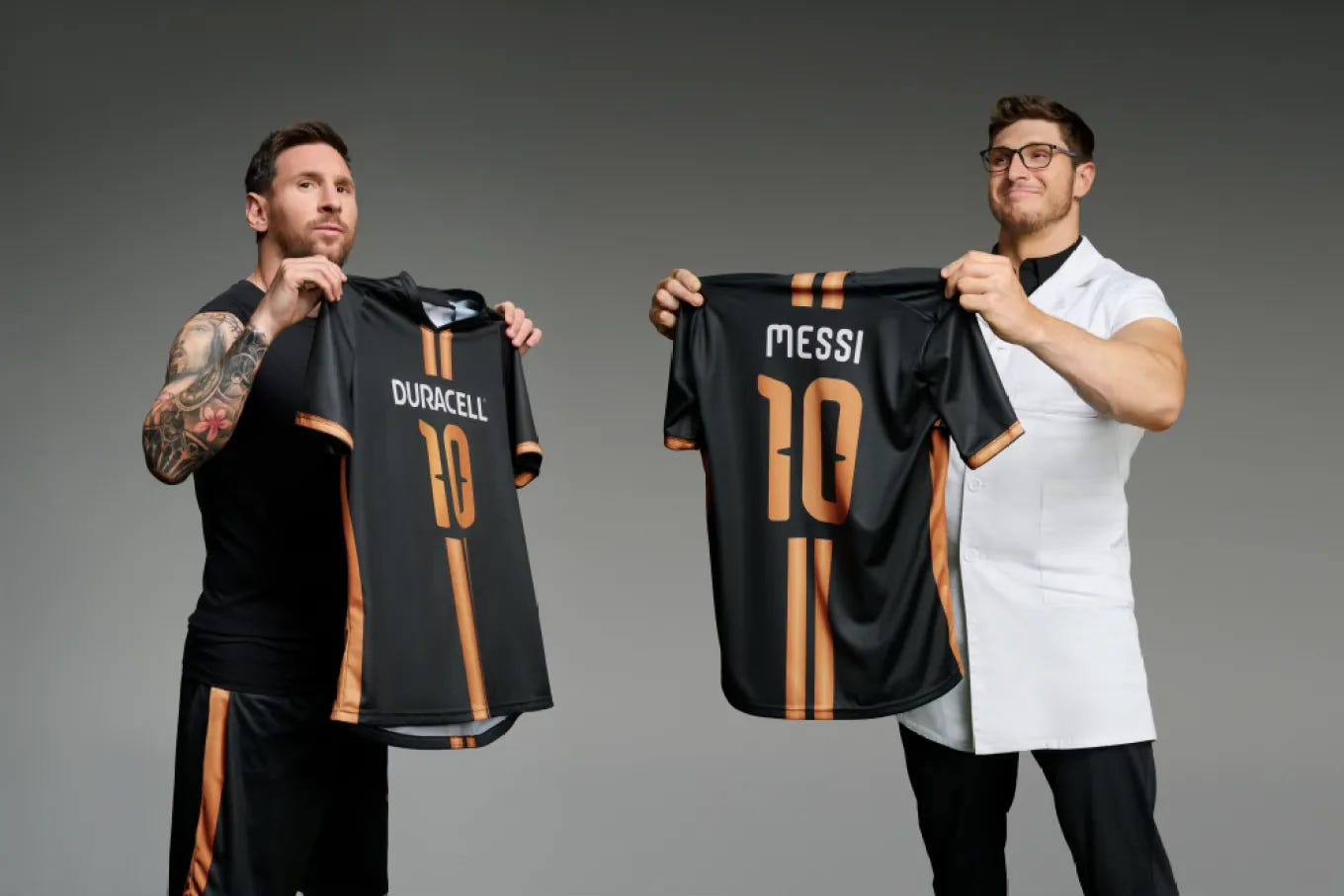
(7) A second Berkshire subsidiary is now in the Lionel Messi business ahead of this summer’s World Cup. A few weeks after NetJets revealed its own partnership with the soccer icon, Duracell followed suit and debuted a new ad campaign in the same vein as its viral Super Bowl commercial with Tom Brady. The Messi spot — in which generic batteries fail him at the worst moment and only Duracell can save the day — will run throughout the heavily-watched tournament.
“When we first did Brady,” said Duracell vice president Todd Midura, “we didn’t have visions necessarily of making this a long-standing campaign or something we would do more than once. But it got a great reception. People got the message of the ad and we thought about what could we do [for] the next step? We looked at what was going to be big in culture next.” The answer: Messi and the World Cup.
(8) Dairy Queen will soon roll out an AI-powered chatbot to take drive-thru orders. The technology comes from Presto — which has already deployed similar systems at Carl’s Jr., Hardee’s, and other quick-service chains — and sports a 90% accuracy rate. To field-test the new system, Dairy Queen handed it the most demanding trial imaginable: the chaos of Free Cone Day. “The bots responded to lines of cars,” said DQ executive vice president Kevin Baartman, “and never got crabby.”
Score one for the machines, I guess.
(9) The Financial Times shared a few additional details about Berkshire’s strategic partnership with Tokio Marine. After Berkshire made the initial approach last summer, the two sides spent months working through the structural mechanics of how any joint acquisitions would actually work. Ajit Jain led negotiations directly with Tokio Marine CEO Masahiro Koike. They expect to focus on “a small number of large deals in areas that make sense for both”. Quality over quantity.
The FT’s reporting also served as a timely reminder of just how elegant the original Japanese trading house investments turned out to be. Last year, Berkshire received an estimated $862 million in dividends from these five holdings — against just $135 million in yen-denominated interest costs used to finance the positions.
Basically, Berkshire borrowed cheaply in yen, bought world-class businesses at reasonable prices, and now collects dividends at a ratio of more than six-to-one over its financing costs. No wonder Charlie Munger once likened these investments to “God opening a chest and just pouring [in] money”.
Greg Abel’s framing, though, was a bit more understated. “We treasure our original five Japanese equity investments,” he told the FT, “and together we continue to look for opportunities of mutual benefit.”
(10) Back when Vicki Hollub took the helm of Occidental Petroleum more than a decade ago, half of the company’s production came from the Middle East and other international operations. But, today, 83% of production occurs right here in the United States. “We made the decision that, geopolitically, we needed to be more of a U.S. company,” she told Fox Business Network last week, and spent much of her time atop the O&G giant repositioning its portfolio in a more domestic direction.
“We [also] more than doubled our resource potential from 2015 to now,” continued Hollub. “We were 668,000 BOE per day of production then [and] we’re 1.4 million now.”
Getting closer and closer to AGM!