
It’s no coincidence that I wrote about Brooks earlier this week.
I am currently down in sunny Florida — battling the heat, humidity, and a little Achilles tendinitis — as I get ready to run (well, more like power-walk) in a few races. I don’t feel terribly optimistic that said Achilles will hold up the entire time, but any and all happy thoughts would be much appreciated!
(1) There is a big difference between admiring Berkshire Hathaway from the outside and absorbing its teachings from within. Here are a few more lessons learned by Jim Weber at Brooks that didn’t quite fit into Tuesday’s article — and how what he found inside Berkshire was unlike any other corporate culture he had ever encountered.
Charlie Munger had a name for the invisible rot that quietly hollows out great companies. He called it the ABCs of business decay: arrogance, bureaucracy, and complacency. “Others with capital and brains will always be competing to breach your moat and take your customers away,” wrote Weber. “Staying humble, remaining curious, and avoiding complacency are essential — especially following great success.” Success, in other words, is not permission to relax — but rather the time to be more vigilant than ever.
Then there is the big man himself. Weber described what it’s like to meet with Warren Buffett one-on-one. “The door [to his office] closes and you have Warren’s undivided attention,” he said. “It’s like he has all the time in the world for you.”
At one point, Weber asked Buffett and vice chairman Greg Abel what information they wanted sent over to track Brooks’s performance. The answer was characteristically minimal. Just the front page of the summary income statement — and whatever else Weber felt worth sharing. No expense reports. No budgets. No other busywork dressed up as accountability.
That same operating philosophy extended to meetings. Berkshire holds exactly one conglomerate-wide gathering each year for all of its business managers. And Buffett typically raced through it as fast as humanly possible. “The only business meeting of the year for one of the most significant companies in America lasted about ten minutes,” marveled Weber.
At one annual meeting, the CEOs of three Berkshire furniture subsidiaries were talking amongst themselves — and Buffett made a beeline over to them. “I hope you aren’t talking about synergies,” he said, “because I bought three great companies [and] I don’t want them to become one.”
And, finally, trust. Which, at Berkshire, is not a feel-good value on a poster — but the entire operating system. “Charlie Munger has often spoken about a ‘seamless web of deserved trust’ as a life pursuit,” wrote Weber, “and Berkshire’s culture reflects that philosophy. As a manager within the company, I can confirm that having [their] trust weighs heavy. Having been given complete trust, I am highly focused on delivering on every level as I alone own all the outcomes.”
(2) April 28 is shaping up to be a big day for Berkshire book fans — with two classic titles getting new editions. First up, Adam Mead fully updated and revised his brilliant Complete Financial History of Berkshire Hathaway with analysis of all the conglomerate’s moves through 2024. The Warren Buffett CEO by Robert Miles will also celebrate its 25th anniversary with a new edition (and plenty of new material). Miles brings the Berkshire story current with profiles of “newer” names like Ted Weschler, Todd Combs, Katie Farmer, and Greg Abel. Can’t wait to read both!
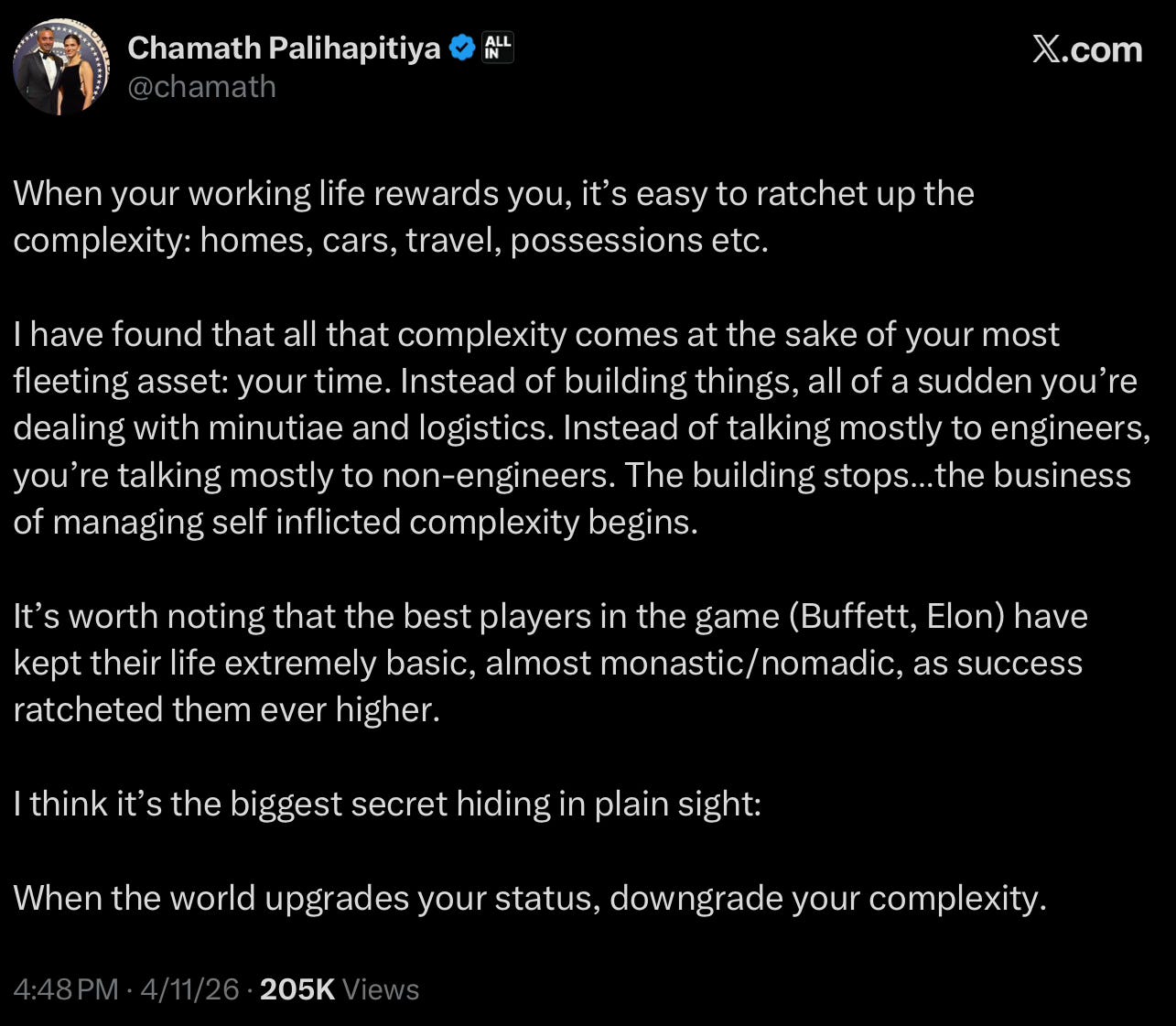
(3) Chamath Palihapitiya of the All-In Podcast mentioned Buffett over on X in a post about how success often leads to a more complex life. And he was smart to do so — because this is something Buffett figured out long ago. He still lives in the same Omaha house he bought in 1958. Same hobbies. Same diet. Same routines. Buffett simply refused to accept the burdens that come with complexity.
He put it plainly in a 2008 interview with Der Spiegel: “I don’t need 15 houses. Owning real estate doesn’t mean much to me. I don’t like to think about things like that. I don’t need 12 boats — or even the world’s largest boat with a crew of 80. I’d have to take care of them [and] worry about them. I get a lot more fun out of life without all the bells and whistles.”
Most people assume wealth buys freedom. Buffett understands that unchecked accumulation does the opposite — trading your time and mental energy for things you never really needed in the first place.
(4) BNSF Railway CEO Katie Farmer is not backing down. This week, she took her fight against the proposed Union Pacific x Norfolk Southern merger to the American Short Line & Regional Railroad Association’s annual conference — and delivered a pointed message to anyone who thinks consolidation is good for the industry.
“[The combined railroad] would be looking to optimize their network,” warned Farmer, “and that’s not always good for customers and it’s not always good for the short line community.” If the deal clears regulatory hurdles and one railroad controls close to 50% of the nation’s rail volume, shippers may find themselves with fewer alternatives, diminished leverage, and ultimately higher rates.
Farmer also addressed the broader fog of geopolitical uncertainty rattling supply chains, which makes long-range planning feel more like guesswork. “We are living in a time where we have got to be flexible and nimble and agile for our customers,” she said, “because to give our customers the perfect forecast of what’s going to happen [would be impossible].”
(5) A federal judge ruled that Berkshire Hathaway Energy must face a proposed antitrust class action alleging it conspired to inflate real estate commissions paid by home sellers — even though its subsidiary, HomeServices of America, already settled the very same claims for $250 million. BHE had argued that the two entities function as a “single enterprise” when it comes to antitrust liability — meaning that the HomeServices settlement should cover the parent, too. Unfortunately, the judge disagreed and BHE remains in the legal crosshairs.
(6) Occidental Petroleum and Chevron announced an oil discovery at the Bandit prospect about 125 miles off the Louisiana coast. Occidental serves as operator of the joint venture with a 45.375% working interest, while Chevron holds 37.125% and Australian energy company Woodside Energy rounds out the group at 17.5%.
The co-owners are evaluating the results before deciding on the next steps, but the logistical path to production looks promising. It has the potential for subsea tie-backs to an adjacent Occidental-operated facility, which could meaningfully accelerate the timeline (and reduce the cost) of bringing these barrels to market.
“We believe this discovery demonstrates the continued importance of the Gulf of America as a strategic source of reliable domestic oil supply that supports long-term energy security,” said Occidental senior vice president Jeff Simmons.
(7) In other energy news, Chevron also struck a landmark asset swap in Venezuela with state-owned Petroleos de Venezuela S.A. that expands its footprint in one of the world’s most resource-rich oil regions. At the center of the deal, Chevron will raise its interest in the Petroindependencia joint venture to 49%, alongside additional rights in the Orinoco Oil Belt. In exchange, it will scale back its stakes in other areas.
This agreement comes hot on the heels of a sweeping reform of the country’s main oil law and the U.S. launch of a $100 billion reconstruction plan for its energy sector.
(8) Coca-Cola will soon become exclusive drink supplier for Marriott International and its nearly 10,000 hotel properties around the world. (Pepsi had held this contract since 1992.) “Marriott’s decision reflects the strength of our brands,” the soft drink giant said in a statement, “and the preference their guests have for our total beverage portfolio.” In an internal communication about the switch, Marriott reportedly noted that Coca-Cola is preferred by more than 70% of the company’s guests.
(9) Exxon Mobil veteran Jeremy Osterstock has replaced Joe Lillo as Pilot CFO. Lillo joined the travel center network alongside CEO Adam Wright in 2023 shortly after Berkshire acquired a controlling interest — and, before that, he worked for Berkshire Hathaway Energy for 25 years. He will stay on as interim controller for the time being, but only until Osterstock — who most recently served as CFO of Exxon Mobil’s Upstream division — settles into his new role.
“Jeremy is known for his focus on developing people, building strong teams, and creating long-term value,” Pilot posted on LinkedIn. “His leadership and passion for working collaboratively and supporting organizations through growth and change will continue to help strengthen Pilot for the future.”
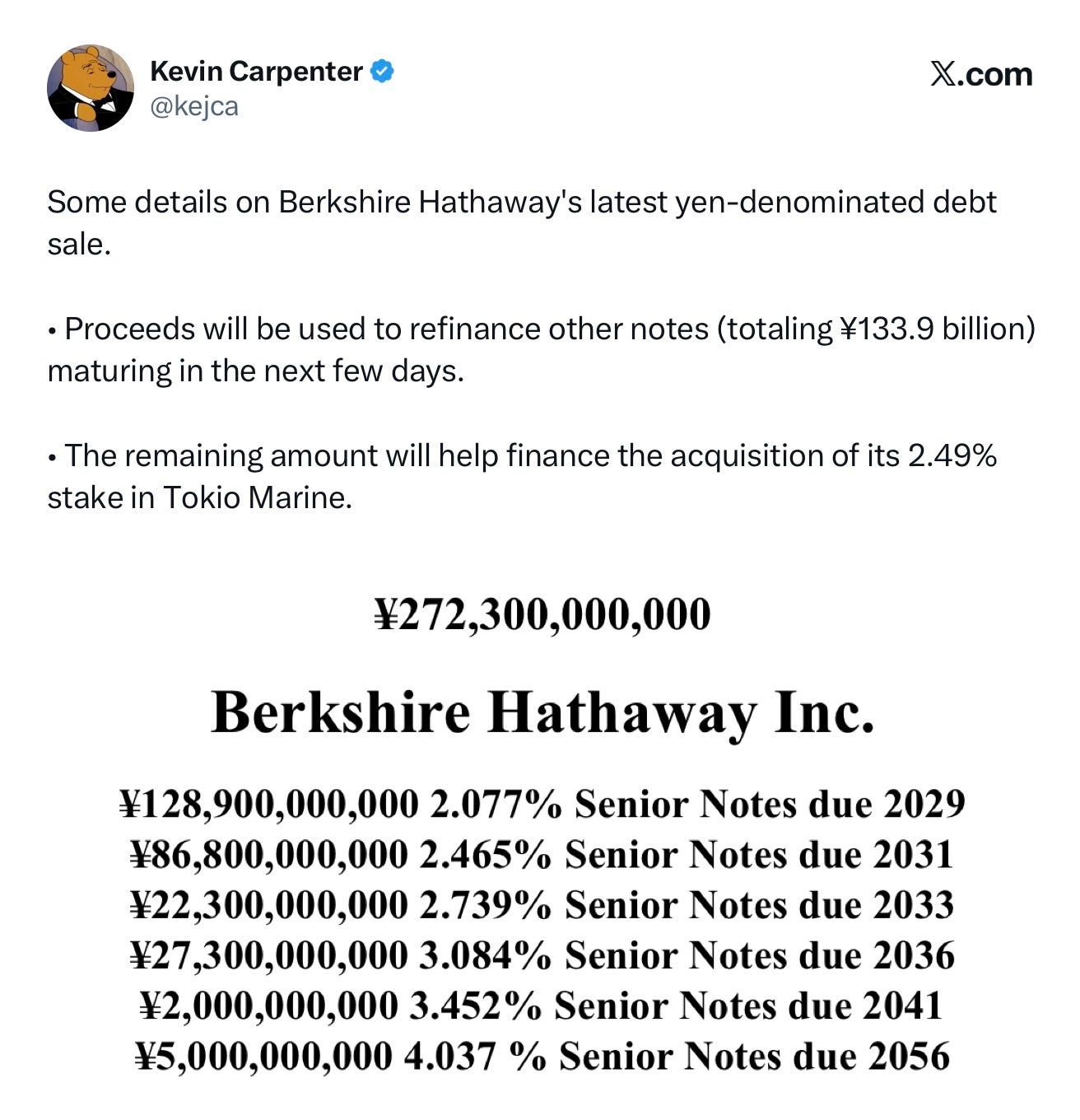
(10) And, finally, additional details on Berkshire’s latest yen-denominated debt sale.
Although he made a fair point about Buffett’s simple lifestyle, I’m not convinced we gain much by amplifying Chamath Palihapitiya’s opinions. The so-called “SPAC King” represents the opposite of what Warren Buffett stands for, and in my view should be given far less attention, not more.
Every time I go to a Marriott, I am reminded just how much I prefer Coke’s products over Pepsi’s.