
The film Pirates of the Caribbean opens with a battered ship limping into port, taking on water at alarming speed. Standing atop the prow, looking remarkably unbothered, is Captain Jack Sparrow. He waits until the very last second — just before his vessel sinks beneath the waves — to hop onto the dock.
He jauntily strides away while the forgotten ship descends into its watery grave.
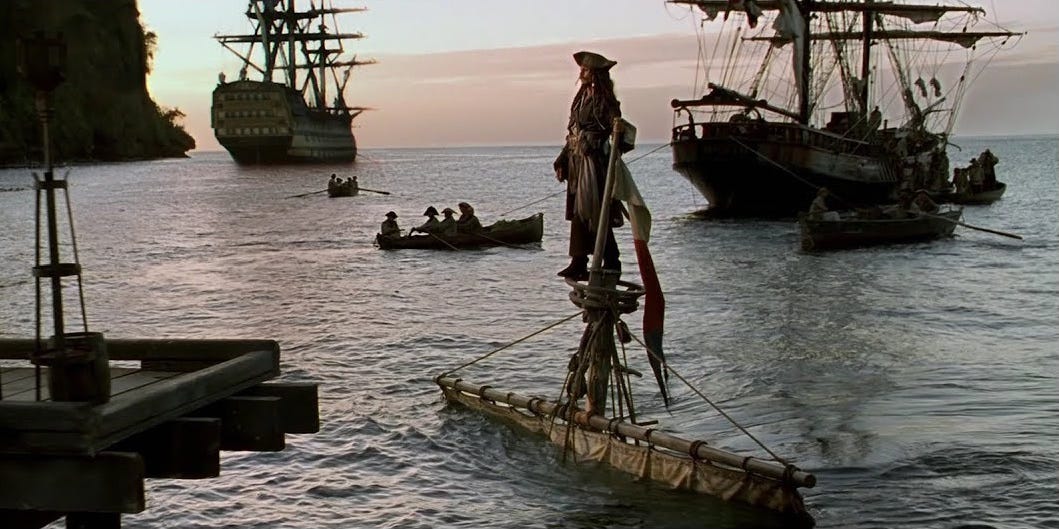
That always seemed to me like an apt visual metaphor for how too many CEOs hand over companies to their successors. A safe and dry landing for them — and no care at all for whatever and whoever gets left behind.
One of the joys of being a Berkshire Hathaway shareholder is the inherent certainty that Warren Buffett would never behave this way.
In the wake of Warren Buffett’s retirement, tributes and retrospectives have poured in from across the financial world, celebrating his legendary run atop Berkshire Hathaway. They are all great reads in their own way, but I see this moment as less of closing the book on Buffett’s career and more the start of his final challenge.
If you’ll permit my little Pirates diversion to continue, Buffett’s aim was never just to steer the good ship Berkshire back into port and hand the wheel over to new CEO Greg Abel. No, he sought to build something — a unique culture, a collection of durable businesses, an exemplar of enlightened capitalism — that would outlast him by decades, perhaps even centuries.
A parent is not judged solely by his or her ability to merely keep a child alive, but also in how that child fares once it goes out into the world on its own. So, too, has Buffett set his ambitions on Berkshire thriving without him. A business machine that can run forever (or as close to forever as any human can ever hope to achieve) without that original visionary at the helm.
Buffett has never been shy about embracing this ambitious standard. In fact, he reiterated it in a new interview (filmed in May) after his retirement announcement. “Who knows what will happen,” he told Becky Quick, “but [Berkshire] has a better chance of being here 100 years from now than any company I can think of.”
This is what Buffett spent the past six decades building — and I, for one, can’t wait to see how it all turns out.
Warren Buffett has always marched to the beat of his own drum. And never more than in how he eschews the short-termism of Wall Street for a time horizon measured in decades and centuries.
It reminds me of what Billy Beane — yes, Mr. Moneyball — once said about the type of mindset that makes managerial legends.
“Most [sports managers] move on to bigger, better jobs and better compensation,” he told The Athletic last year, “but there are a few icons in each sport. And one reason I think they’re great — whether it be Sir Alex Ferguson, Bill Belichick, Nick Saban in Alabama — is because they ran their club like they’re never going to leave, which is unusual, and the decisions they make are for the future.”
Just like Buffett and Munger ran Berkshire like they would never leave — but nevertheless stocked the cupboards full of assets for the next generation to enjoy.
They made decisions not just for the Berkshire of that particular moment, but for the Berkshire of 2050 and 2125. Acquisitions that might lack the glamour and flash to set hearts racing in the AI age, but also ones unlikely to ever fall by the wayside. Like a Class I railroad, insurers, consumer brands, building products, utilities, and more.
There are no guarantees that these subsidiaries will, in fact, stand the test of time — but they unmistakably reflect a long-term vision of durability and necessity.
Can Berkshire Hathaway’s unique culture survive its creators?
Warren Buffett and Charlie Munger did not merely allocate capital; they also allocated values and wisdom to anyone with ears to hear. They preached patience, warned against envy and excess, and transformed their annual meeting into a masterclass on living a meaningful life. For decades, they did all they could to inoculate Berkshire — and its shareholder base — against stupidity.
That foundation should stand the conglomerate in good stead. “Once it’s built,” said Munger, “you don’t need to be Warren and Charlie. What we have is a framework for looking at investments.”
Greg Abel now becomes keeper of that flame — while hopefully resisting the temptation to ossify the company or constantly ask “What Would Warren Do?” He seems more than capable of walking this very fine line between old and new.
More than anything, Berkshire’s long-term fate might rest on its shareholders. Buffett and Munger assiduously cultivated a group of like-minded partners who were not just after a quick buck. Ones who understood and embraced their policy of no stock splits or dividends. Hopefully, in the future, these shareholders will serve as an immune system of sorts against whatever Wall Street shenanigans come knocking at the door.
In his recent Thanksgiving message, Warren Buffett acknowledged that no one can beat Father Time. But, in a sense, he has positioned Berkshire Hathaway to do the next best thing: stewarding capital and imparting wisdom across generations. Like it or not, the best businesses can long outlive any human body.
If, many decades from now, Berkshire remains one of the most valuable companies in the world, crowds of shareholders still gather together in Omaha each spring, and the timeless words of Warren and Charlie continue to echo in our ears, then Buffett will indeed have found a way to get one over on Father Time.
Returning to the seafaring metaphor from above, Buffett built a ship designed to sail through storms he will never see, captained by people he (eventually) will never know, but carrying a map he drew by hand. This is the start of his final challenge. And, for the first time, he will be watching from the shore.
Warren once said to me that he graded his performance as manager by how few shares traded. He then added, with a smile, that that view was not shared by his CEO colleagues or in Wall Street. I stored his comment away wondering what he meant. Years later, Morningstar identified the top mutual funds over 10 years. The winner was Ken Heebner’s CGM fund. He beat the index by a comfortable margin. MS then, somehow, calculated the performance of individual CGM shareholders. On average, they underperformed not only CGM, but the index by wide margins. The lesson here became clear: Heebner focused his attention on beating the market, which he did, but he paid little attention to inculcating his shareholders to be patient shareholders—they tended to buy high and sell low. And he didn’t attract 40,000 shareholders to his annual meetings.
Great read! I’ve never met Mr. Buffett, but his wisdom has mentored me for decades. My journey to (and now through) financial independence has been shaped by his insistence on patience, rationality, and sound judgment. He’s leaving Berkshire not just in good hands, but with the right DNA.
Jeff Bezos once observed that most large companies last 30-plus years, not 100-plus. Berkshire looks built to be the exception.