
The most interesting line in the Financial Times oral history of the Salomon Brothers bond-trading scandal comes courtesy of bestselling author Michael Lewis.
“I didn’t fully appreciate all of [Warren] Buffett’s virtues at the time he became involved in Salomon,” said Lewis, “but he’s one of a kind and I hope he lives forever.”
Because, if you know the history of these two men circa the Salomon era, “didn’t fully appreciate” might just qualify as the mother of all understatements.
Let’s rewind to 1987 for a minute: Salomon Brothers, one of Wall Street’s most venerable firms, found itself in the crosshairs of takeover artist Ronald Perelman. To fend off his unwanted advances, Salomon sold $700 million of convertible preferred stock — 12% of the entire company — to Berkshire Hathaway, complete with a 9% dividend and a lower-than-expected conversion premium.
Buffett had saved Salomon from being swallowed whole, but some (including Lewis) complained that he extracted unusually generous terms for doing so.
What at first might have looked like a sweetheart deal soon turned into a nightmare. Salomon trader Paul Mozer submitted false bids in Treasury auctions in 1990 and 1991 to skirt the 35% cap on what any single buyer could purchase of an issue. When Mozer finally fessed up, CEO John Gutfreund and president Thomas Strauss inexplicably sat on that information and did nothing. Needless to say, their silence did not endear the firm to regulators when the whole mess eventually came to light.
The Treasury Department initially barred Salomon from bidding in government bond auctions — effectively a death sentence for a bond house. So Buffett again rode to the rescue, took over as interim chairman, and successfully lobbied the Treasury to relent on the worst of Salomon’s punishment.
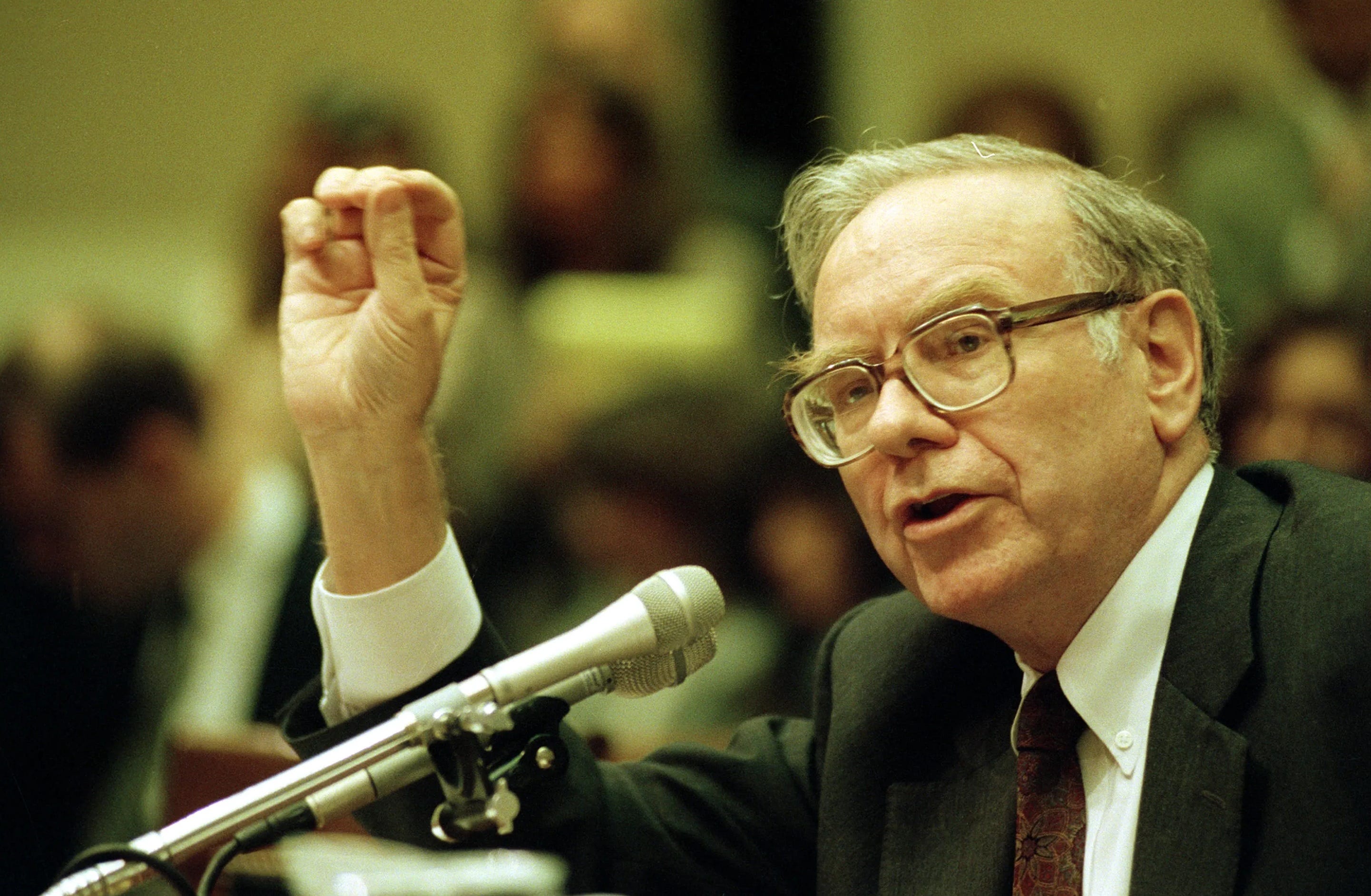
“Buffett saved us,” former Salomon managing director Eric Rosenfeld told the FT. “There’s no question about that. Without him, Salomon would have gone bankrupt. And no one else could have done what he did.”
Lewis, though, was not nearly so impressed.
In 1992, the Liar’s Poker author wrote a scathing essay for The New Republic about the entire Salomon affair titled “The Temptation of St. Warren”. The gist was that Buffett, after years of condemning Wall Street’s excesses, had compromised his principles and ethics by playing white knight for one of its worst offenders.
Over four pages, Lewis judged Buffett’s actions as “a delicious gap between what the moralist said and what he did” and charged him as having “sold his reputation”. He also accused Buffett of “vanity about his reputation as an investment genius” and, most bizarrely, “a vaguely thuggish if-you’re-so-smart-why-am-I-so-rich routine” aimed at the EMH true believers who dismissed his record as mere luck.
I’m not sure anyone has ever called Buffett “thuggish” before. Even “vaguely” so.
All in all, it’s a fairly maddening article that even Lewis now agrees has not aged well.
He eventually started to come around when, in 2008, he looked back on Buffett’s time at Salomon with a far kinder eye while reviewing The Snowball for The New Republic.
Long ago, after Buffett became entangled with Salomon Brothers, I wrote a long critical article about him for this magazine … The piece dwelled on Buffett’s small hypocrisies and downplayed his virtues.
Even then I thought that his virtues far outweighed his vices1 and felt a bit like the guy who, having grown weary of hearing others drone on about the physical perfection of some supermodel, went to the beach with a camera and snapped a photo of her cellulite.
It takes considerable grace for a writer to admit that he had his thumb on the scale when presenting Buffett’s actions and intentions. So please don’t take anything here as a dunk on Lewis. If anything, I’m happy to see by his recent comments to the FT that his re-evaluation of Buffett’s virtue is now complete.
That said, Lewis raised two points that warrant further discussion…
Why did Warren Buffett get involved with Salomon Brothers in the first place?
It’s a question many Berkshire Hathaway shareholders surely asked themselves when the news first broke. And one that even Carol Loomis, a close friend of Buffett and a longtime financial journalist, grappled with in the pages of Fortune magazine.
It was easy to see why Gutfreund welcomed Warren Buffett, White Knight. It was less easy to see why Buffett wanted to hook up with Salomon, much less trust it with this mint, $700 million — the largest amount he’d ever invested in a single company. Over the years, Buffett had derided investment bankers, deploring their enthusiasm for deals that provided huge fees but were turkeys for their clients.
He has also spoken often of wanting to work only with people he likes. So here he was, handing over mountains of Berkshire’s carefully accumulated and husbanded cash to the high-living, cigar-chomping, corner-cutting crowd [at Salomon] soon to be made infamous in Liar’s Poker.
Salomon was a surprise — to just about everyone — but surprise is not hypocrisy.
To outsiders, it probably looked like Buffett had stepped into a nest of vipers for no good reason. But, to Buffett, he was simply backing someone he trusted and admired.
Most retellings of the Salomon saga skip a crucial detail: Buffett already knew and liked Salomon CEO John Gutfreund. A decade earlier, Gutfreund and Salomon had helped haul GEICO back from the brink of bankruptcy — and, in doing so, earned themselves a place in Buffett’s good books.
See, GEICO was no ordinary company to Buffett.
Business-wise, it was his first love.
But, by the mid-1970s, GEICO was dying. A disastrous stretch of under-reserving, in the teeth of spiraling inflation, had lost the insurer more than $150 million across 1975 and the first half of 1976. The stock crashed from a high of $61 to just $2 a share. GEICO was on life support and few believed new CEO Jack Byrne could revive it.
Near the bottom, Buffett waded back in with a $4 million investment — and, crucially, lent his name to Byrne’s mad scramble to line up reinsurance for the gaping holes in GEICO’s balance sheet. It was touch and go for a while, but a lifeline eventually arrived from Gutfreund and Salomon, who agreed to underwrite a $76 million stock offering that provided the insurer with the capital it desperately needed.
GEICO survived, in no small part thanks to Gutfreund’s faith in Buffett and Byrne. “GEICO’s savior, John Gutfreund, became one of a tiny handful of modern Wall Street figures whom Buffett genuinely admired,” wrote Alice Schroeder in The Snowball.
Buffett is not a man who lets sentiment steer a deal. He would never knowingly put Berkshire’s capital at risk just to help out a friend. But it strains belief (mine, anyway) that this history counted for nothing when it came to saving Salomon.
In Buffett’s eyes, Gutfreund was not just another rapacious Wall Street banker. He was a man who had been in a foxhole with Buffett once before and earned his trust.
Michael Lewis wrote: “One cannot blame [Buffett] for doing whatever is necessary to protect his $700 million, but it is absurd to cast his activity as a moral crusade.”
What Lewis missed, though, was that much more than $700 million was at stake.
It’s easy to forget that Buffett was not just Salomon’s biggest outside investor. He was also a director. And a director owes fiduciary duty to every shareholder. When Buffett took his seat on the board in 1987, his obligations and responsibilities expanded well beyond whatever money Berkshire had at risk.
Salomon’s other shareholders — big and small — were counting on him. So, too, were countless employees who had done nothing wrong and whose livelihoods hung on the firm’s survival. And, of course, Berkshire’s own shareholders, who had entrusted him to make intelligent decisions with (in some cases) their life savings.
He could have fooled me.
The Salomon episode is a reminder that leadership isn’t tested when everything works. Buffett’s real value appeared when the institution was in crisis and someone had to take responsibility.