
Berkshire Hathaway rarely offers predictions.
Not about the stock market, not about the economy, and not even about the operating businesses it knows better than anyone.
Forecasting just isn’t their style.
Back in February, though, new CEO Greg Abel’s first letter to shareholders offered a couple hints at what might lie ahead. First, he warned that insurance was headed for tougher times — as competition poured into a market that had enjoyed several years of boffo results. And, second, he committed to flexing his management muscles when and where necessary to bring “operational excellence” to the subsidiaries.
Now, after going through Berkshire’s 10-Q with a fine-tooth comb, his commentary reads almost like a script for the third quarter. Abel told us exactly what to expect.
Let’s start with what matters — and what doesn’t — in any Berkshire Hathaway earnings report. Berkshire owns a mountain of stocks and, under current accounting rules, every unrealized gain and loss on those holdings gets swept straight into net earnings. One quarter, the market cheers and profits soar. The next, it sneezes and they crater. The result is a bottom line that lurches around like a ship in a storm — even when nothing about the business has actually changed.
Warren Buffett and Charlie Munger cared more about the profit machine humming along underneath all that noise: freight trains rumbling across the continent, insurers collecting premiums, utilities keeping the lights on from coast to coast, and even a candy shop delighting customers’ taste buds.
Operating earnings better capture this underlying business performance, while sidestepping the often wild swings in stock prices that dominate the net earnings number. Berkshire’s 10-Q spells it out: “We believe that investment gains and losses, whether realized from dispositions or unrealized from changes in market prices and exchange rates, are often meaningless in understanding our reported periodic results or evaluating our periodic economic performance.”
Q3 2026 shows why this distinction matters.
Berkshire’s net earnings fell 28%, which looks alarming on the surface. But nearly that entire “drop” can be explained by lower unrealized investment gains than a year ago.
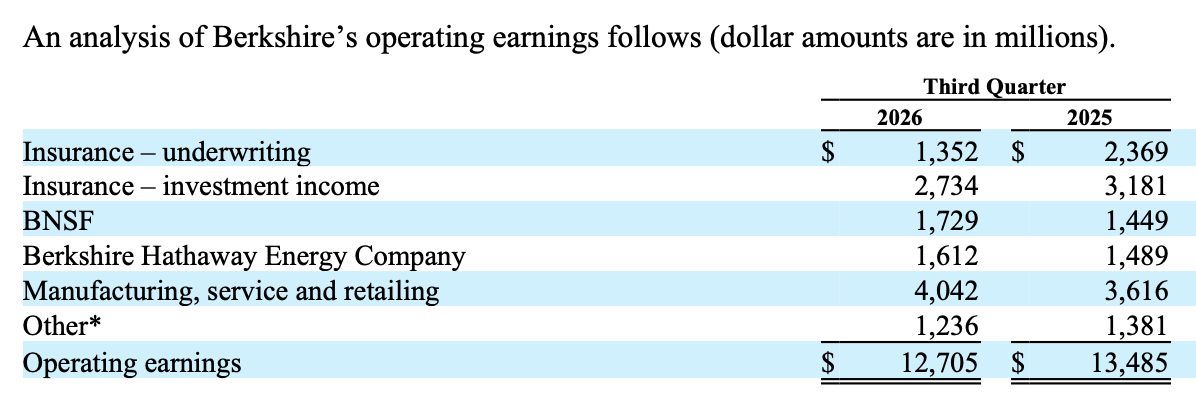
So let’s turn to Buffett and Munger’s preferred metric of operating earnings. Which, on the surface, declined 5.8% to $12.7 billion — but was weighed down by foreign currency fluctuations out of Berkshire’s control.
Once you remove the $343 million “loss” from Q3 2026 and the $331 million “gain” in 2025, operating earnings come in at a relatively flat -0.8% for the quarter.
(I make this adjustment each and every time whether it flatters Berkshire or not. Last quarter, filtering out FX noise reduced the operating earnings gain by 10+ percentage points.)
The still-enormous cash pile continues to (slowly) shrink.
Berkshire closed the third quarter with $356.9 billion in cash, down 2% from the prior quarter. That’s largely because Greg Abel shelled out $9.6 billion repurchasing shares over this three-month period, bringing Berkshire’s total for the year to $14.4 billion.
He also appears to have bought in another ~2,550 Class A equivalents for ~$2 billion during the first four weeks of October. Though, as Berkshire’s stock price shot up like a rocket in recent weeks, it’s probably safe to assume the pace has since slowed.
On the subject of share repurchases, the 10-Q still states: “Berkshire’s common stock repurchase program currently permits Berkshire to repurchase shares any time that Berkshire’s CEO, after consultation with the Chairman of the Board, believes that the repurchase price is below Berkshire’s intrinsic value, conservatively determined.”
Up until six weeks ago, that all made perfect sense. But in light of Warren Buffett stepping down as chairman and handing the role to his son Howard, I thought there might be a change to the language of this section. I assume — perhaps incorrectly — that Abel need not consult with Howard Buffett before making this type of decision.
Berkshire may have bought back a lot of its own stock, but not so much anyone else’s.
After a big round of stock buying last quarter, Berkshire slipped back into net seller territory this time out. All in all, $2.4 billion worth of stock came in and $2.8 billion hit the exits. Not exactly the kind of numbers that set your heart racing ahead of next week’s 13-F filing. Berkshire’s stock pickers kept things pretty quiet.
The conglomerate’s portfolio finished the quarter valued at $335.5 billion and remains every bit as concentrated as ever. The top five holdings — Apple, American Express, Coca-Cola, Alphabet, and Bank of America — account for 65% of the entire portfolio.
Before he retired, Warren Buffett warned that the recent run of underwriting results would be nearly impossible to sustain. Greg Abel echoed him in this year’s letter to shareholders, pointing to a softer insurance cycle ahead.
The message seemed clear. Don’t mistake the 2023-2025 peak for the new normal.
And the numbers are starting to bear that out. After-tax underwriting earnings fell 42.9% to $1.4 billion, down from $2.4 billion a year ago. All three segments (GEICO, Primary, and Reinsurance) earned less this time around.
GEICO stands out as the biggest culprit. Pre-tax earnings were practically cut in half to $982 million. The auto insurer’s combined ratio climbed from 84.3% to a still-quite-decent 91.4% as claims frequency and severity increased. (These results look very similar to last quarter’s, in both dollar figures and percentage decline.) Still profitable, but losses and expenses are mounting. A big part of the GEICO story is its attempt to grow again after years of retrenchment. Policies-in-force did grow, but premiums written fell due to lower average premium per policy.
BH Primary’s pre-tax earnings tumbled all the way from $506 million down to $119 million. Premiums written dropped 7.9% with year-to-date declines at RSUI, BHHC, MedPro, and GUARD. No matter who’s in charge, Berkshire won’t write business just to write it. If the price ain’t right, Berkshire ain’t interested.
BH Reinsurance’s property/casualty division also saw its earnings chopped from $1.1 billion down to $780 million. And while premiums written did rise on the reinsurance side, that’s mostly due to the agreement with Tokio Marine to assume a portion of its non-life book. Otherwise, “premium volumes were constrained by increased price competition in U.S. property markets.”
BNSF Railway had another strong quarter — with earnings up 19.3% to $1.7 billion.
Revenue grew 14.7% on a 3.9% rise in freight volume. Consumer, agricultural/energy, and industrial products all posted mid-single-digit gains, while coal slid 8.4%. Average revenue per car/unit jumped 10.5%, largely because of fuel surcharges. (These are extra fees added on top of the shipping rate whenever diesel prices rise above a certain line. It basically ensures the railroad doesn’t get stuck absorbing the cost when fuel spikes.)
Fuel cuts both way, though. BNSF’s operating expenses soared $547 million — with $468 million of that being fuel-related, a 60.6% jump from a year ago.
BNSF certainly seems to be getting itself back on the right track, but still lags behind its rivals in terms of efficiency. The Berkshire-owned railroad notched an improved 63.9% operating ratio in the third quarter, still a ways back of Union Pacific at 59.1%.
Berkshire Hathaway Energy boosted earnings by 8.3%, though the growth was not exactly spread evenly among its segments. U.S. Utilities and Natural Gas Pipelines each racked up gains of more than 20% in the third quarter. Other Energy Businesses slipped slightly. And the real estate brokerage brought up the rear with a 36.4% drop.
U.S. Utilities, in particular, benefited from higher retail and wholesale volumes — plus higher retail rates. Customers are simply using (and being delivered by BHE) more electricity. So far this year, retail volumes are up 7.2% at MidAmerican Energy, 6.3% at NV Energy, and 4.0% at PacifiCorp.
Pilot might be shedding its problem child status.
The travel center network’s pre-tax earnings came in at $183 million, a dramatic turnaround from the $17 million loss a year ago. Revenue jumped 48.4%, driven largely by higher fuel prices and slightly higher retail fuel volume.
And Pilot’s bottom line could have looked even better. The quarter included a $116 million loss tied to an unnamed business disposition that closed on November 2. After a little sleuthing, this appears to be the sale of Pilot Water Solutions — a water-disposal unit operating in the oilfield services sector — to Select Water Solutions.
The sprawling Manufacturing, Service & Retailing (MSR) segment also delivered big numbers with $4 billion in overall earnings.
Some subsidiaries of note:
Precision Castparts kept on rolling with $3.2 billion of revenue on strong demand for aerospace and industrial gas turbine products, as pre-tax earnings rocketed up 29.6%. The 10-Q notes that similar growth in the future will depend on increasing production and expanding capacity to meet ravenous customer demand.
Other industrial products standouts like Lubrizol, Marmon, and IMC each increased their revenue and earnings in the third quarter.
The acquisition of Taylor Morrison reshuffled the deck a bit in the housing products group. Berkshire grouped TMHC with Clayton Homes to form the new “Homebuilding Businesses” classification. Revenue from homebuilding activities increased by $1.2 billion in the quarter — $1.1 billion of which came courtesy of TMHC after its acquisition date of July 24. Earnings grew 6.7% to $575 million.
Earnings for the other building products businesses sank 12.3%. Which, believe it or not, was better than the 29.2% decline over in consumer products.
McLane suffered reverses in both revenue (-6.5%) and earnings (-21.9%).
At Berkshire Hathaway Automotive — which accounts for 71% of the retailing group’s revenue — sales inched up 0.8%, even as its pre-tax earnings dipped 6.2%. The other retailers collectively grew revenue slightly, even as some battled sluggish demand, and their combined earnings rose a modest $14 million.
The repurchase clause still has the CEO consulting the Chairman, and that seat just changed hands. Does the wording get tested only when the stock stops looking cheap, or is there a past filing where the language shifted around a leadership change?
I’m disappointed by the lack of clarity related to Warren’s move to Chairman Emeritus. Although he retired as CEO at the beginning of the year, he was clearly still in an active role coming into the office every day and making large investment decisions such as Alphabet. He was also clearly in the loop on repurchase decisions as Chairman, consistent with the stated language in SEC filings. Now we are left to wonder if he’s still in the loop on any of these things since September and I take the SEC filing literally to mean that Greg is indeed consulting with Howard on repurchases. That’s not to say Warren is totally sidelined. I’m sure he’s involved in some way. But we are left to speculate on the extent of his involvement and this is material information. I am sure this will all be cleared up in Greg’s annual letter but that’s over three months away. I am not sure Warren will discuss this in his Thanksgiving letter, if he chooses to write one. Anyway, the business is doing well overall and that’s the key thing to watch.