
Berkshire Hathaway filed its 13F on Friday afternoon — revealing to the public its domestic investment activity from the second quarter.
This one was especially anticipated (at least by me) because, for the first time in three-and-a-half years, Berkshire had been a net buyer of stocks in the quarter.
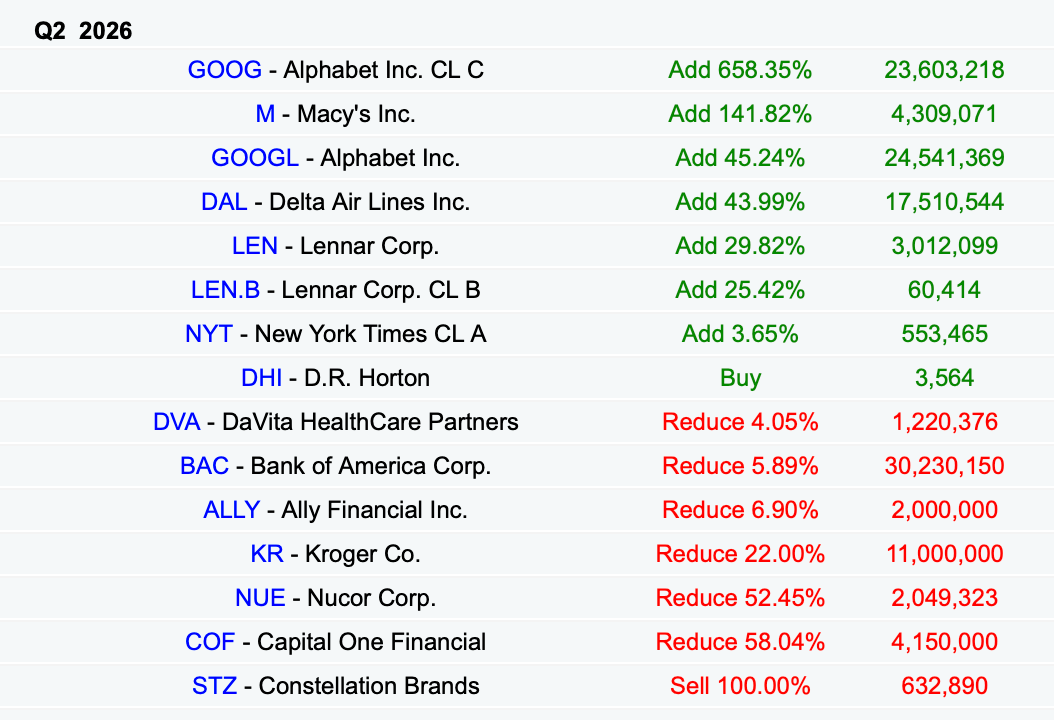
As it turned out, the vast majority of said buying came on Alphabet stock — with Berkshire also adding minor amounts to a few existing positions and welcoming one old friend back into the fold. But what these moves may have lacked in surprise was more than made up for in significance. Warren Buffett, who initiated the Alphabet stake last year, is not going quietly into the night, but instead doubling down on what could be the final major investment conviction of his storied career.
Here’s a sentence that still seems hard to believe: Two of Berkshire Hathaway’s top three stock holdings are technology companies.
In the second quarter, Berkshire piled on more than 48 million additional shares of Alphabet, catapulting the search giant past Coca-Cola into the #3 spot in Berkshire’s portfolio. Where else but Berkshire can you build a $36.6 billion position (current market value) from scratch in under a year?
We already knew Buffett and co. scooped up $10 billion of Alphabet via private placement in June — but that turned out to only be part of the story. Berkshire also nabbed another ~20 million shares on the open market at a cost of $7 billion or so.
Add it all up and Alphabet accounted for $17 billion of the $23.5 billion that Berkshire spent on new stock purchases in the second quarter.
And they might not be finished yet. Like most hyperscalers, Alphabet’s stock has been a bit of a rollercoaster lately — spending plenty of time below the prices paid in that private placement ($351.81 per A share and $348.20 per B share). For all we know, they could still be buying more as we speak.
Either way, Alphabet is now an absolute cornerstone of the Berkshire portfolio.
Speaking with CNBC last month, Buffett made his confidence in Alphabet clear.
“I think it is more likely to be a winner based on their record than probably 95% of what gets merchandised through Wall Street,” he told Becky Quick.
This is not the same capital-light compounding machine it once was, but Buffett nevertheless still sees outperformance as the base case. And while Alphabet’s AI-related capital expenditures are absolutely staggering — and polarizing among shareholders and the market at large — the business itself is humming right along.
I mean, it’s hard to argue with their Q2 results. Overall revenue grew 24% to $119.8 billion, Search revenue up 17%, Cloud revenue soared 82% (with a jaw-dropping $514 billion backlog), the Gemini app now has 950 million monthly users, and on and on.
That’s the real story. Alphabet’s edge was never one person, one team, or one product cycle. It’s the infrastructure, a brand so dominant it became a verb, the custom silicon, the distribution, and the fact that Alphabet owns its models from top to bottom.
Like Berkshire itself — or the Japanese trading houses Buffett loves so much — Alphabet has so many layers and moving parts that it can be hard to wrap your head around all of it at once. (Or at least that’s what I tell myself so I don’t feel stupid.) Search continues to print cash. Cloud is scaling rapidly. Gemini has cracked the top tier of AI models while running on Alphabet’s own tensor chips. Not to mention speculative side bets like Waymo robotaxis, 14% ownership of Anthropic, or its $77 billion stake in SpaceX.
But Berkshire — and Buffett — are not blind to the risks. “The real question with Google and all of its competitors now is they’re all laying out hundreds of billions [on capital expenditures],” Buffett told CNBC. “That’s real money. That’s the game they’re playing now.”
Alphabet, for its part, plans to spend $195-205 billion on cap-ex this year alone — with management already admitting that 2027 will go meaningfully higher. Those are just really, really big numbers. I don’t know what else to say.
I don’t have a crystal ball for how any of this will shake out, but both Alphabet and Berkshire obviously believe the eventual returns will justify the outlay. Alphabet isn’t just spending its own cash pile, but continually raising outside capital — and shelving share repurchases for the time being — to divert all resources into AI infrastructure.
Berkshire, meanwhile, has spent decades proving that cash doesn’t burn a hole in its pockets. Sitting patiently by, through plenty of criticism, waiting for the right pitch to cross the plate. It beggars belief that Buffett would suddenly abandon that discipline on what may be the final major investment of his career. Or that Greg Abel would start off his tenure as CEO — and steward of the most closely watched stock portfolio on the planet — by taking excessive risk.
None of this guarantees the Alphabet investment will pay off. But the people making it have, in my eyes, earned the benefit of the doubt.
Okay, enough about Alphabet. Berkshire also added another $1.6 billion to Delta Air Lines and topped up its Macy’s and New York Times holdings.
I had also wondered if Berkshire might dump its other homebuilding stocks in light of the Taylor Morrison acquisition — in the same way that BNSF’s arrival heralded the sale of the conglomerate’s other railroad stocks. Nope. Wrong again. Instead, Berkshire increased its Lennar position, adding nearly 30% to the Class A shares and 25% to the Class B, and brought D.R. Horton back in from the cold.
Even so, these homebuilder stock holdings (including NVR) are among the smallest in Berkshire’s entire portfolio. The new DHI 0.00%↑ investment is just ~$500,000. (A fortune to me, something smaller than a rounding error to Berkshire.) To put that in perspective, the next smallest position is Jefferies Financial Group at $24 million.
The D.R. Horton situation is, frankly, a little odd. And about as un-Berkshire-like as it gets. The company first bought shares in the second quarter of 2023, then fully exited two quarters later. It reopened the position in the first quarter of 2025, began selling almost immediately, and was out again by the third quarter. And, now, it’s back again. Maybe the third time really is the charm.
Berkshire has now sold Bank of America stock for eight straight quarters. After this latest 5.9% cut, the holding stands at 483.4 million shares — less than half its peak of more than one billion shares two years ago. BAC 0.00%↑ was not the only financial name on the chopping block: Capital One and Ally Financial also got trimmed.
There were also modest reductions in Nucor and Kroger, along with DaVita — though that last one is the result of a Share Repurchase Agreement between the two companies rather than any change in Berkshire’s opinion of the business.
Perhaps the least surprising move was the complete exit from Constellation Brands. Berkshire had already unloaded almost all of that stake in the first quarter, so this was mostly just a matter of mopping up what remained.
And, finally, this little nugget, courtesy of the Wall Street Journal, suggests that one or two Todd Combs investments may have survived last quarter’s cull after all.
Berkshire liquidated most of the roughly 15 positions during the first quarter that were managed by Todd Combs, Buffett told the Wall Street Journal in May. Buffett added that it is possible the conglomerate retained some of Combs’s stocks, and it is unclear whether Berkshire ended June with any of those holdings.
The massive capex at Alphabet (and many others) can be put into some perspective by comparing it to the capex of BNSF and BHE. Those subsidiaries spend massively on capex each year but are totally dwarfed by the AI buildout. I’m a skeptic of how this all turns out but I don’t mind Berkshire’s Alphabet investment at its current size. It’s still a small bet in the context of Berkshire as a whole (although large as a percentage of publicly traded portfolio).
Great summary. One interesting question to me is how Warren views the media/news landscape at the moment, in light of the NYT position. It's his biggest move in papers in over 10 years, and his only attempt at a position with a big news organization for 25 or so years (?).